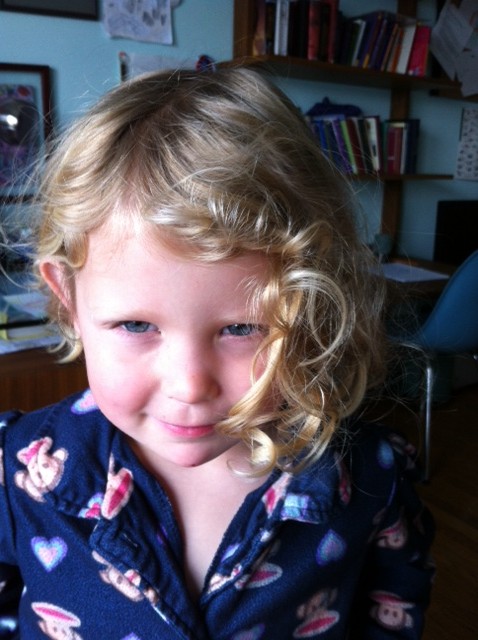
But after a month or so with that blue-eyed image, I’ve decided to go with the the brown eye color of my second daughter and me. If you read Reel Girl, you know that as a brown-haired, brown-eyed child, I was endlessly annoyed by the ubiquity of blond, blue-eyed heroines. I still am. Here is me.
I hate reading a book I otherwise adore, Ramona, where the protagonist complains about her “boring” brown hair and brown eyes. I especially hate reading this part to my brown-haired, brown-eyed daughter. So fuck that. This is my blog, after all, and so Reel Girl gets brown eyes.
I also like brown eyes on Reel Girl because though her look is based on images of my three Caucasian daughters, brown-eyes make her a little more ethnically ambiguous. So here’s the new Reel Girl and feel free to name your favorite brown-eyed heroines here. I’m collecting.
Just wanted to say sorry for all the typos on Reel Girl. This is the deal. I have little time to blog, and so I blog very fast. Usually, I’ve been thinking about what I want to write when I’m driving my car, up in the middle of the night, or pushing my kid on the swing. By the time I get to the keyboard, my ideas are clear but time is fleeting. Mostly, I work on my book when I’m alone in the house but I sneak off to blog by stealing minutes when my kids and my husband are around. Invariably, while I’m writing, someone is screaming for me or there is something else I need to be doing.
I’ve tried to save drafts for later when I can proofread them, but I’ve learned that those posts never go up. For me, blogging seems to be a combination of obsessively thought out ideas that are finally shared compulsively and impulsively. Once the blog has been posted, unlike one that hasn’t been, I do go back and proofread because it’s out there for everyone to see. My pride won’t let me leave up “higher” when I meant to write “hire.”
Sometimes I give myself a hard time about this fast and sloppy style of writing. No matter how important what you’re saying is, if you spell it wrong, it can look stupid. But, as I wrote, the fast posting in fits and spurts is the only way I am able to blog in way that is fulfilling and useful. Also, that’s what kind of cool about blogging, especially if in other areas of your life, including writing, you’ve got to be exact and fastidious.
I’m posting this without re-reading and will probably be revisiting when I find a minute or two again in the day to check all the typos.
I get a lot of people telling me the issues that I blog about are stupid, irrelevant, or don’t exist at all and how miserable my children must be to have me as a mother. Then, once in a while, I get a comment like this from Jessica. Thank you, Jessica! You rock.
Hello, I’m only 14 but I’m just commenting here to express how so so so grateful and relieved I am to FINALLY find out that I’m not the only one who pays attention to all the sexism that is really all around us, even when everyone else I know thinks I’m over reacting and have gone bonkers. Especially people my age.
Whenever my little sister turns on the TV to watch cartoons, I can’t help but start counting how many female characters there are, yet only to groan in frustration afterwards because there are always more male characters. And the main characters are never females. That is, unless the show’s target audience are girls.
Or whenever I read a book, or watch a movie. It’s always the same. Always.
Even the fact that we’re supposed to use our Dad’s surname as our own, instead of our Mom’s.
I feel truly angry about all this. I wish there were something I could do.
Yet I’ve learned keep it to myself, because whenever I tell someone, anyone, they just roll their eyes like I’m crazy. I’m just a stupid little girl. No one takes it seriously. No one takes ME seriously But they should. Because all this has to change.
It’s really sad how other girls/women don’t even seem to care. I honestly don’t understand. How could anyone think that sexism is “gone”?!
Anyway, I’m so grateful that I have found this blog. Thank you so much. I’m sure you are a very, very good mum.
The bad news is Reel Girl ran out of bandwith not once, but twice. ARGH.
The good news is the sexist posters from kids movies are back up. If you haven’t seen them, you can look now.
You should also check out Laura Beck’s post on Jezebel. She writes about the bad influence the limited representations of females has on kids:
As for how it leaves girls feeling, this is probably something many of us can relate to. As a child, I strived for the perfection of a Disney Princess, perhaps subconsciously knowing I’d never achieve that, I started imagining myself in the shoes of more adventurous male characters. I’ve talked to many women who’ve had similar experiences, this sort of transference. Lacking decent female role models, it’s not surprising many girls live stories through the eyes of boys and men.
There’s a passage in Margaret Cho’s hilarious 2002 autobiography I’m the One That I Want that talks about this in terms of race. This is paraphrased, but she basically says that, as a young girls, she couldn’t wait to grow up and become white like everyone on TV. Heartbreaking, and I think this experience resonates with many people. When you don’t see yourself reflected in media, you push yourself into it.
Beck also goes on to tell a creepy but unsurprising story:
Now, a personal anecdote. I have a friend who’s a writer working in children’s TV. She’s constantly taking meetings and pitching stories, and she told me when she first started in the business, she pitched stories with girl leads. However, after being told to change the protagonist to a male character more than a few times — and once being told to actually turn the movie into a live action rom com for adult women!? — she now pitches almost entirely male-driven stories. And guess what? She’s selling.
What is surprising is that so many people buy the bullshit line: “Girls will see movies about boys, but boys won’t see movies about girls.”
How can we see cool movies about girls when no one will make them?
Today is my birthday! Right now my husband is dropping our three kids off at my sisters, then we get to see a movie and go out for dinner. I am so excited and feel incredibly lucky for my family. I am trying to decide between “Zero Dark Thirty” and “Silver Linings Playbook.” I’m thinking I’ll go with ZDT because I know I will see SLP eventually, but I think if I don’t see ZDT in a theater, I may not see it at all.
Since I’ve been blogging, I usually write every year about how great my 40s are. This continues to be the best decade of my life so far. I am really enjoying the ages that my kids are right now: 3, 6, and 9. I feel so lucky I’ve already been pregnant and given birth and now I get to enjoy these remarkable creatures. No more babies to keep me up at night, no more poo diapers to change, but I’m still, pretty much, their favorite person to hang out with. Two of them can read which is so fun. Last night, the two older ones and I all got in my bed with our separate books, cuddled up and listened to the rain on the roof. It was heaven.
Career-wise, in your 40s, you realize you don’t have time to waste. It’s now or never. At least, that’s how I feel. A couple years ago, I left a non-profit I was with since I was 28. I stopped doing what I felt I should do and followed my heart. Now I am writing an MG book which is my passion, along with blogging which helps me stay connected while I write. It’s scary, taking the leap and pursuing a dream, but it also feels so great and right to focus my time, energy, and resources on what makes me happy, fulfilled, and what really matters to me. My energy feels endless.
January 6 is the Twelfth Night, the epiphany. I hope you all have a magical, insightful year. I think 2013 is going to be amazing.
I’m thrilled that my letter is in a national magazine with the reach and audience that the New York Times has. It’s a tiny step, obviously, but I’m hoping that more people, and parents especially, will start realizing and reacting to how sexist kidworld is. Almost every time children go to the movies, they learn that boys are more important than girls.
What about movies for children? I have three young daughters. Aside from the pink ghetto, kids’ media — whether PBS or Disney — put male characters front and center. Female characters are sidelined or not there at all — just look at the posters for children’s movies (with the exception of ‘‘Brave’’). There is no reason for the imaginary world to be sexist.
Margot Magowan, San Francisco, posted on nytimes.com
Here’s to hoping female characters in children’s movies fare better in 2013.
Can you imagine gender equality? Really see it? What does it look like to you? Or is it impossible to picture because we are so influenced by how things “are?” Or perhaps, too difficult because my idea of gender equality could be different than your idea of gender equality?
I’ve been thinking about all of this because I’ve been hard at work on Reel Girl’s new logo. I’m creating the image with an exceptional artist I met on line, and in order to come up with the right symbol, we’ve been revisiting the blog’s title, tagline, and mission.
“Imagining gender equality in the fantasy world” has never felt more appropriate. Now, more than ever, three years after I started blogging, I am amazed, fascinated, inspired, and disheartened by the way I see fantasy create reality and reality create fantasy in an endless loop.
What happens when children, even pre-birth, experience a world that is so saturated with gender segregation? How do parents’s expectations for their sons versus their daughters affect brain growth?
However, the traditional dichotomy of nature versus nurture that has dominated Western philosophy and psychology has been profoundly challenged by recent advances in neurophysiology. The stratification model of human experience, nature versus nurture– was predicated on the assumption that human biology was a complete package at birth…
The brain of the newborn, we now know, is only partially developed. Nerve cells and neural pathways are incomplete at birth; they are shaped to a considerable extent by the baby’s experience with others.
To show this visually, Mitchell uses Escher’s “Drawing Hands.”
Would this be a great logo for my blog or what? If only Escher wouldn’t mind. I could stick some jewelry on those fingers, maybe some cool nail polish too? A Bic pen “for her” in those big, strong hands?
Too heady, I know. But looking at this image reminded me of Lise Eliot, author of Pink Brain, Blue Brain. She wrote:
“Babies are born ready to absorb the sounds, grammar, and intonation of any language, but then the brain wires it up only to perceive and produce a specific language. After puberty, its possible to learn another language but far more difficult. I think of gender differences similarly. The ones that exist become amplified by the two different cultures that boys and girls are immersed in from birth. This contributes to the way their emotional and cognitive circuits get wired.”
Both Mitchell and Eliot support the idea that humans are born into the world with “potentials.” Qualities humans are designed for can “turn on” or “emerge.”
These ideas on brain development take on the basic assumptions of Enlightenment, the driving theory behind the last century, which Mitchell summarizes as “a correct, rational, scientific, fantasy-free way to understand the world.” Mitchell summarizes the Enlightenment world view into three basic assumptions:
(1) All genuine questions have answers
(2) All true answers are discoverable and teachable to others
(3) All answers are in principle compatible
Mitchell describes reality, or realities, instead where fantasy and reality continually create each other i.e. the Escher drawing. Mitchell writes:
It is the hallmark of the shift in basic psychoanalytic sensibility that the prototype of mental health for many contemporary psychoanalyitc authors is not the scientist but the artist. A continual objective take on reality is regarded as neither possible nor valuable in contrast to the ability to develop and move in and out of different perspectives of reality.
When I read this, it seemed radical to me. Most of everything I’ve ever learned or heard about artists is not a model for psychological health, but rather that they are “totured.” Artists are crazy, art comes out of pain, and all that.
There is one exception I recalled that I blogged about as well: Peter Kramer’s Against Depression. Kramer was inspired to write this book after his more famous Listening to Prozac. Everywhere he went on that book tour, people asked: “What if van Gogh had taken Prozac? What about Kierkegaard?”
Kramer argues artists are not creative because of their depression but in spite of it. Depression is a “stuck switch,” the opposite of resilience. Art, a career of it, requires resilience. (So does long term romance, by the way which is the real topic of Mitchell’s fantastic book.)
I have to say, these theories make sense as far as my experience writing a Middle Grade book. I’ve been working on it for a year and a half, and if I’ve learned one thing about writing: it requires optimism and faith.
I’ve written novels before, but I’ve never been able to stick with one as it gets torn up and put back together multiple times. I think the difference here is that I know a MG book requires plot. (Maybe all books do, but I was never so committed to plot before.) I can’t tell you how many times I’ve faced a plot problem that completely overwhelmed me. The only way to get through the challenge is to believe there is a way out, a solution. The only way to find that solution is to be able to try on multiple outcomes. For me, that is a terrifying process of allowing one version to disintegrate and another to emerge. But, the more I do it, the better I get at it. It’s a skill, like any other skill.
Mitchell wrote Can Love Last in 2002. In the ten years since, more information on “brain plasticity” continues to emerge and support his thesis. It seems that not only is Mitchell correct (he died soon after he wrote the book) but that the only place he was off was in believing “brain plasticity” didn’t last for a lifetime.
Until recently, our 20s were considered the point when our brain’s wiring was basically complete. But new evidence suggests that not only can we learn into old age, but the structure of our brains can continue to change and develop.
Could imagination be far more powerful and useful than we, well, ever imagined?
Writing a Middle Grade book has been one of the best experiences of my life. I am learning so much, and every day is a new adventure, both in my story and the real world.
About five years ago, I wrote a novel and though it got me an agent, the book didn’t sell. Editors universally told my agent: great writing, not enough plot/ motor. ( An adapted part of the novel is published as a short story in an anthology that came out last year from Ecco, Sugar In My Bowl)
Plot had never really interested me, as a reader and as a viewer of movies as well. Most important to me is character and then, in books, language. Watching movies, I would often space out during the plot and then, five minutes later, have no idea what was going on.
In my book that didn’t sell, most of the action takes place in the character’s head. I still love to read books like that and, like any writer dealing with rejection, can think of many examples of writers in that style– Virgina Woolf, come on, people! But you know where that style absolutely will not fly? A Middle Grade book, a book for kids. Kids don’t want to read pages of introspection. They want action, adventure, but still, thank goodness, they want loveable characters.
Writing the MG book has shown me why plot is important in general: a fiction writer needs to show, not tell. Everyone knows that, but I never really understood it until this book. A writer can describe a character but what really shows the reader who she is her actions. It’s like how I tell my kids, “It’s not what you say, it’s what you do.” You know how I learned that, I mean deeply learned it? From being a parent. I can talk at my kids until I’m blue in the face, or I can show them. The latter is the only thing, the only thing, that really works. I think that is why being a parent is so challenging; if you’re yelling at your kid, you’ve got to look at your own pattern of behavior and who wants to do that?
Before, when I was told that all narratives had a pattern, I was kind of annoyed. Weren’t we all more original than that? Recently, I turned to Joseph Campbell’s Hero with a Thousand Faces, a book thatI’d first read in my early twenties. Back then, and now at 43, it’s obvious that the “universal quest pattern” is tailored to male experience. For example, Campbell has sections on “Woman as Temptress” and also, throughout, females are the prizes to be won, the reward at the end of the adventure, or as with Odysseus, symbolic of homecoming.
I wondered, for a female hero, do we just flip the genders to complete the quest pattern?
In some ways, yes. As I’ve blogged about quite a bit, if women were mostly in power positions, if women had written most of the narratives that create our “universal” cultural imaginary, men would be sidelined, sexual objects, and relegated to the romance section.
“Inclination to help” doesn’t create heroes, it waters down drama. Writers need to raise the stakes, not lower them, or the story is a bore. Writers don’t raise the stakes because humans are tragic and neurotic, we love pain blah blah blah. Writers raise the stakes so the readers will “get it;” feel it. A kid feels like “the walls are caving in” when she has to move to a new city, share a room with her sister, share a toy, invite someone she doesn’t want to to her party; a writer literally will show the walls caving in, a world being destroyed.
So this is how I’ve come to understand internal action, action in a character’s head and physical action. I believe in the pattern Joseph Campbell lays out, and believe that it is a universal human experience/ sequence: (the call to adventure; refusal of the call; supernatural aid– the “helpers” I just blogged about; crossing the first threshold and on and on. Read the book, it’s great.) But here is where I differ with Campbell. I don’t think this pattern is representative of a life story, that a narrative mirrors the trajectory of a life experience compacted. I think its the opposite: the narrative pattern is the magnification of a moment. These moments we experience every day. Many “little” moments are heroic and feel heroic to us. Getting out of bed for my three year old, cleaning our room, sitting down to write. On a slightly larger level: quitting a job, starting a job, going to a new school, going on a trip, making a new friend, learning a new skill. We take risks that may seem small to an observer but to us, in our hearts and our heads, they are full of drama and symbolism.
This is why it gets me so upset that females aren’t protagonists in children’s media nearly enough. That in the rare occasions that females do get to star, most often they are surrounded by male characters; that females, except for the pink ghetto, almost always exist in the minority. Males have whole cast of characters to help them take risks and achieve their dreams. Females don’t.
But instead of lecturing you about now much a new model is needed, I’m going to get back to writing that book and show you.
Look what happened today at breakfast: 3 kids spontaneously pulled out books and started to read. I got to drink my coffee in peace! Moments like this are so rare, I took a photo, and I’m posting it, even though the picture is not that great.
Rose, age 3, is reading Giant Meatball. (She can’t read but doesn’t know that.)
Alice, age 6, is reading Green Eggs and Ham. She is just starting to really read and love it. Dr. Seuss’s rhyming word patterns are great for this stage, though his total lack of female characters drives me bats.
Lucy, age 9, is reading Wildwood. I am going to blog about this book; it’s great and stars a sister who courageously rescues her little brother.
One of the hardest (and most unexpected) challenges for me in transitioning from single life to momhood was organization.
I have never been an organized person at home. I didn’t really get the point. It always seemed like there were better things to do. I was of the opinion: Why make your bed if it’s just going to get messed up again?
But one husband and three kids later, I get the point: If we are not organized, the whole family ceases to function. We can either have peaceful mornings or stress and yelling with everyone leaving the house in a horrible mood. So much of it just comes down to organization. Who knew?
Since realizing this tool, I’ve become so curious how other parents, not natural Martha Stewarts, pull it off. So, please, write in your tips.
With 3 kids in a 3 bedroom house, this is how we do it:
First life-changing decision: a quiet room and a loud room.
I had so much trouble keeping the kids’ schoolbooks and homework organized. This led to lost homework, missed homework, frustrated teachers, and the previously mentioned yelling and stress.
So we came up with a quiet room and a loud room. One room for work, study, art: a place where you can go and count on for quiet:
Every kid keeps her own books above her desk.
There’s also the grown-up desk. (Pretend you don’t see my husband’s drums.)
I realize the irony that the “sleeping” room is called the “loud” room. Unfortunately, the label is accurate. 2 kids sleep in bunk beds:
Another parent may have made the beds before taking the photo, but at least the kids made those themselves.
The littlest kid was sleeping in a toddler bed that fit the room perfectly. Then, she grew. Our solution was to build this loft bed. (Don’t worry, she’s in the lower bunk, not up there.)
Making use of every bit of space, and because we all love to read, we made the landing on the stairs into a reading nook. I love this because it feels like an extra room.
It even doubles as “the music room” (This is where my husband’s drums should be.)
In case you can’t tell, I am wildly procrastinating writing my book. The good news is, that this summer, in spite of traveling, sickness, blogging obsessions, and various other unforeseen drama: Part One is done! YAY I am so excited about it.