Mom writes teacher about gender bias in homework

Ever noticed your children’s homework shows boys playing sports while girls bake cookies? It drives me bats. I’m so happy that mom, Elizabeth Mandel, wrote a letter to her child’s teacher about gender bias in homework. All of us should do this. Here’s part of her letter:


My daughter is absolutely thriving in your classroom. As you know, she has a particular affinity for math, and she adores doing math homework (I hope she feels like this about homework forever).


While sitting with her while she was doing her math homework tonight, I noticed that in the examples, Shawn and Mike have robots and baseballs, while Lucy makes sandwiches for her friends. As I mentioned when we met last month, I am very invested in keeping my daughters, and all girls, interested in STEM subjects, and in diminishing the subtle cues that contribute to the gender gap in all areas. I strongly feel, and I am supported by research that shows, that subtle cues that assign boys certain interests and girls certain interests are absorbed by young children and impact how they see their roles in the classroom and in society at large.

Thank you, Elizabeth, for this letter. Thank you to Pigtail Pals for posting it. You can read the rest of the letter and information about the teacher’s reply on Pigtail Pals Facebook page.

New evidence shows early women were artists and warriors

All week, I’ve been trying to get a minute to blog about new evidence showing the earliest artists were women. From NBC News:

Alongside drawings of bison and horses, the first painters left clues to their identity on the stone walls of caves, blowing red-brown paint through rough tubes and stenciling outlines of their palms. New analysis of ancient handprints in France and Spain suggests that most of those early artists were women.


This is a surprise, since most archaeologists have assumed it was men who had been making the cave art. One interpretation is that early humans painted animals to influence the presence and fate of real animals that they’d find on their hunt, and it’s widely accepted that it was the men who found and killed dinner.


But a new study indicates that the majority of handprints found near cave art were made by women, based on their overall size and relative lengths of their fingers.

“The assumption that most people made was it had something to do with hunting magic,” Penn State archaeologist Dean Snow, who has been scrutinizing hand prints for a decade, told NBC News. The new work challenges the theory that it was mostly men, who hunted, that made those first creative marks.


Another reason we thought it was men all along? Male archeologists from modern society where gender roles are rigid and well-defined — they found the art. “[M]ale archaeologists were doing the work,” Snow said, and it’s possible that “had something to do with it.”

What, rigid gender roles now, in 2013? But I thought were we beyond all that, living in a post-feminist world and all. Here are some stats on women artists today:

stats

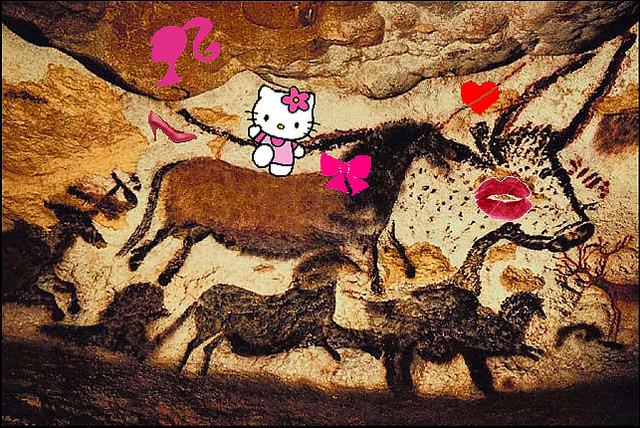
Want to see something else fucked up? Looking for this story, I typed “cavewomen artists” into Google. Here’s the first match I got.cavewomen

A pink bow, are you kidding me? Looks like Disney has been here or perhaps, just Hollywood.

Think gender bias is restricted to archeology “experts”? Here’s another story from NBC News

Last month, archaeologists announced a stunning find: a completely sealed tomb cut into the rock in Tuscany, Italy. The untouched tomb held what looked like the body of an Etruscan prince holding a spear, along with the ashes of his wife. Several news outlets reported on the discovery of the 2,600-year-old warrior prince.


But the grave held one more surprise. A bone analysis has revealed the warrior prince was actually a princess…The mix-up highlights just how easily both modern and old biases can color the interpretation of ancient graves.


I see these two stories as related, showing how gender bias today influences how we interpret at the past. It’s funny because I’ve heard a lot from others that I look at the world through a feminist lens, but what if it’s not me wearing the funny glasses?

 Update: Commenter says pic is satirical (like the first) in which case, I like it. Maybe it’s saying, “Is this the proof archeologists are looking for to attribute work to women?”

Apparently, I need an animator

Look what ad just showed up on my Facebook feed.


Is your face sending mixed messages? It could be. Your “resting face” may make you seem angry, grumpy or unapproachable to others. This may affect both your private and public lives.So what can be done about this problem?Injectable cosmetics can also help women who look grumpy when they are at peace. Botox injections can smooth worry lines between the eyes and raise the eyebrows. Dermal fillers an round out the chin and mouth or fill in deep creases that make you look upset.If you don’t like the way your face looks when you are at rest, you may want to ask Dr. Kulick for advice. He will be able to point you in the direction of aesthetic procedures that could help alleviate this problem:
Is your face sending mixed messages? It could be. Your "resting face" may make you seem angry, grumpy or unapproachable to others. This may affect both your private and public lives.</p><br /><br /><br /><br /><br /><br /><br />
<p>So what can be done about this problem?</p><br /><br /><br /><br /><br /><br /><br />
<p>Injectable cosmetics can also help women who look grumpy when they are at peace. Botox injections can smooth worry lines between the eyes and raise the eyebrows. Dermal fillers an round out the chin and mouth or fill in deep creases that make you look upset.</p><br /><br /><br /><br /><br /><br /><br />
<p>If you don't like the way your face looks when you are at rest, you may want to ask Dr. Kulick for advice. He will be able to point you in the direction of aesthetic procedures that could help alleviate this problem: http://bit.ly/1e337x4</p><br /><br /><br /><br /><br /><br /><br />
<p>F
Can’t I just get a Disney animator to fix my image up? Who needs facial expressions anyway? Oh, that’s right, men do.
The Society Pages posts the PR for “The Counselor.”
Screenshot_114
Screenshot_27
 The men are not considered unattractive by virtue of the fact that you can tell they have skin.  The women, in contrast, have faces that are so smooth that they look inhuman; their images are halfway between photograph and cartoon.  Amazingly, this treatment of images of men and women is so ubiquitous that it now looks more or less normal to us.
Fantasy creates reality and reality creates fantasy in an endless loop.

Art teacher for kids says ‘almost without fail, girls create male characters’

Lori comments on Reel Gir’s post Speaking of art as derivative:

I teach clay classes for kids, and we often do character sculptures. I encourage the kids to create characters and make up stories about them, and almost without fail, the girls will create male characters. If they do make female characters, they always have long hair, a dress, and big eyelashes, and are defined by how pretty they are, or some romantic plot point. Any monsters or animals were male by default. I actually ended up running a couple of workshops specifically aimed at girls to encourage them to create stories about female protagonists, and to talk about gender stereotypes in storytelling because of this. It’s so pervasive, they don’t even realize they’re doing it, or that they are free to create anything different.


This makes me so sad about the limits gender bias in our culture is putting on children’s imaginations. Lino DiSalvo and co, do you see the problem now? What are you going to do about it?

Cloudy With Little Chance of Girls Starring In Animated Movies

Yesterday, I took my three daughters ages 4, 7, and 10, to see “Cloudy With a Chance of Meatballs 2.” We all enjoyed the movie. The animation was great, though the story was a little weak. I didn’t really understand why the evil guy had to do his evil deeds. But here’s the real problem with the movie. Here are the main characters:

Cloudy-With-a-Chance-of-Meatballs-2

There are 5 males and 2 females. The female ape, Barb, is the sidekick to the evil villain and the female human, Sam Sparks, is the sidekick for the hero. Sam is a classic Minority Feisty. She is a great character, smart, compassionate, and brave. She’s a scientist. But her role in the movie is to support the hero.

The last 6 movies I’ve seen with my daughters– “Despicable Me,” “Monsters Inc,” “Smurfs 2,” “Percy Jackson and the Sea of Monsters” “Turbo” and “Planes, all reviewed on Reel Girl, have the same pathetic gender ratio.

Females are half of the kid population so why are they conistently presented as a minority in movies made for children?

See Reel Girls’ Gallery of Girls Gone Missing From Children’s Movies in 2013


Speaking of art as derivative…

My daughter, inspired by the movie, “Soul Surfer”  about champion Bethany Hamilton, made this:

bethanyart

Why do you think so many little girls make art about pretty girls in pretty dresses? Because that’s just “natural”?

Last Spring, when another daughter of mine was 3 years old, she made made a magical creature called a flying Brachiosaurus.

creature

Here’s what she said to her teacher about it:

This is its little wings for going to tree because it has to. These are horns to help him pick up people. He steps on giant people. He flies on mountains or houses and it doesn’t break.

Why do you think her creature is male? I looked at the other children’s art work in her class, half of them girls. Every picture I saw described a male creature.

When another daughter was asked to write a story during school in third grade, she used a male protagonist. When I asked her why she chose a male, she said, “Because everybody did.”

Can you imagine if in a class of third graders, every kid wrote about about female protagonists? Do you think the teacher would notice?

Here is that daughter’s drawing of Harry Potter. This is the same daughter who later drew Bethany Hamilton.

harry

This scene didn’t happen in the book but she was inspired by the book. Her drawing shows a typical gender matrix you see all over children’s media: 2 boys, 1 girl; boy in front, girl behind; text supports male competition and victory.

Here is a picture my middle daughter drew at age 6 while I was reading her the first part of the first Harry Potter.

witchphoto

She made up this character, a witch and her cat soaring through the sky on a broom surrounded by many crescent moons. I was pretty psyched about this witch, but then again, we were only at the beginning of Book 1. Would she still make a female character, front and center, after Book 7?

Here is a make-a-plate my older sister made when she was a kid and obsessed with fairytales.

kim

It’s fascinating to me how much care she took to represent ethnic diversity in these women. Also, their faces are so animated, even though they’re dead. I was impressed but grossed out and disturbed when my sister drew this. She wanted to know which one I thought was the prettiest.

I sought out “Soul Surfer” for my daughters, because I’m always on the look out for images and narratives about heroic females to inspire them. That’s why I started this blog, as a place to collect stories and pictures. But unfortunately, these kinds of depictions of women and girls are far too rare in kidworld, not to mention the grown-up one.

What happens to the imagination of children, and the adults they become, when we live in in a world where heroic girls go missing?


But not all female artists are feminists?

After I posted asking what the world would be like if we hadn’t been experiencing it through male artists for thousands of years, commenters respond that not all women are feminists. I agree, absolutely, and many men are feminists. Also, art is derivative, responding to what came before, as Marian writes:

women artists (and writers) being capable of playing into negative gender stereotypes. Even feminist artists, often in unexpected and subtle ways. We’ve all been conditioned and it’s very hard to get beyond it, consistently.

Very true and makes me think of Gloria Steinem’s comment on Miley Cyrus:

“I wish we didn’t have to be nude to be noticed … But given the game as it exists, women make decisions. For instance, the Miss America contest is in all of its states … the single greatest source of scholarship money for women in the United States. If a contest based only on appearance was the single greatest source of scholarship money for men, we would be saying, “This is why China wins.” You know? It’s ridiculous. But that’s the way the culture is. I think that we need to change the culture, not blame the people that are playing the only game that exists.”

I doubt the world will ever be dominated by the vision of one group the way it has been for so long by white men. But what I was imagining in my post is: what if our worldview had always been dominated by women as a group, the way it has been dominated by men? Men’s roles in narratives would repetitively show up as lovers, sex objects, prizes to win after a quest. When we don’t have diversity, we get stereotypes.

Women, just like men, come in all shapes and sizes. The problem is, right now, we are allowed to exist only within extremely limited parameters. Why animation fascinates me is that it’s a clear intersection of art and story, and also, a fantasy world where anything is possible, marketed to children. It’s clear to see how sexism is packaged, recycled, and sold to a new generation. Or at least, clear to me.


What happens when we experience the world through male artists?

Animator and I are in a debate which I just blogged about, and in response, he sent me a link to to a post about Joanna Quinn, one of the top animators in Europe.

Joanna_Quinn_animation_Lg-fmt-462x279

Here’s Quinn’s quote in response to DiSalvo’s comment:

It’s not at all hard to draw women showing emotions. The only challenge is the notion of beauty. It’s really hard to inject lots of emotion because you’re always trying to keep them [as] this sort of shiny, lovely character. I am looking for strong female characters that are not always gorgeous.


So there’s yet another established artist referring to the need for female characters to be pretty.

joannaquinn-women

As I so often do on this blog, I ask again: What is “pretty”? For a male protagonist, his attractiveness is often determined in a narrative by his actions. Rescuing someone, risking pursuing a dream, brilliance, talent, excelling at a sport or at a skill, is all attractive. While for a female character, her “attractiveness” is usually primarily determined by how well her appearance fits into a limited definition of physical beauty.

joannaquinn

Animator directed me to Joanna Quinn’s site, writing that I would enjoy her work. I do! Please check it out, and think about what our world would look like if female artists dominated our cultural imaginary the way male artists do. How differently would we see women and how differently would we see men? For thousands of years, females have been limited to supporting roles in stories that star men. Don’t you think it’s about time for that to change? At least, for our kids?

Disney says its sexism is all in your pretty little head

Responding to the furor over the sexist comments made by the head animator of “Frozen,” Disney makes this statement:

Animation is an intricate and complex art form. These comments were recklessly taken out of context. As part of a roundtable discussion, the animator was describing some technical aspects of CG animation and not making a general comment on animating females versus males or other characters.

OK, here’s the comment again:

Historically speaking, animating female characters are really, really difficult, ’cause they have to go through these range of emotions, but they’re very, very — you have to keep them pretty and they’re very sensitive to — you can get them off a model very quickly. So, having a film with two hero female characters was really tough, and having them both in the scene and look very different if they’re echoing the same expression; that Elsa looking angry looks different from Anna (Kristen Bell) being angry.

What context alters the belief that female characters need to be pretty and that it is diffuclt to make two females look different from each other? The “context” that Lino is speaking in is actually a biased and sexist one where the poor guy is stating a common belief in the industry. Lino is a scapegoat only for his honesty. Since Lino’s comments, I’ve put several posts on Reel Girl on the “differences” between drawing female and male characters. There is Christopher Hart who instructs,

With male comic characters, you can mold their bodies into many different shapes, producing a wide range of cool characters. It’s not so easy with women. Women in comics are, by and large, attractive—even the villains.


There is Marc Crilley’s video how-to featuring famous female characters and showing how their bodies get distorted. There are also artists who show the sexism in clothing and in pose of male versus female superheroes.

Want a little more context? In animated movies for children, there is a pattern of male protagonists while female characters get stuck in supporting roles. Not only that but females, who are half of the kid population, are presented in movies for children as if they were a minority.

Animator has been commenting on Reel Girl in defense of Disney and Lino. It is from him that I heard today about Disney’s response. After posting a link to Disney’s quote, Animator writes:

So my suspicions are confirmed. This is all controversy for the sake of controversy.

Could Lino have chosen his words more carefully since he’s being interviewed for a website where most of the readers have never animated before and don’t understand the terminology?

Yeah, probably.

Now I’ve learned, if you work for Disney, WATCH WHAT YOU SAY or you’ll be branded and eeevvvviiilll sexist pig if you say something that can even slightly be taken out of context.

Disney is an easy target for some good ‘ol fashioned “outrage” and fabricated controversy after all.


First of all, I could not be less interested in controversy for the sake of controversy. I get accused of this all the time, I’m trying to get eyeballs to my blog, making a big deal out of nothing. Sexism in children’s media is a really big deal. Sexism in children’s media is a repeated pattern kids are exposed to that shapes who they are and who they become. There is no good reason for the fantasy world to be sexist. It is a made up world, anything can happen, yet the sexism of the real world, where males star and females support, is echoed here. I wish children’s media were not sexist. I love movies and books and TV. I love stories. Whenever I find examples where females are heroes, protagonists, and celebrated, I blog about it.

As for Animator’s next comment, I am actually glad that Lino did not choose his words more carefully. He spoke honestly, and I’m grateful for that.

Animator is not the only one upset with me. I got this Tweet from Allie Molina:

Your post on how Disney allegedly “Undermines Women” is absolutely idiotic and misleading. Read this:http://akaito.co.vu/post/64020438666/on-frozen-and-misconceptions-floating-around-tumblr


I went to Molina’s Tumblr. Here’s what she says:

Frozen got a name change because it is NOT the Snow Queen. It’s loosely based off of it just like Ponyo was loosely based off of the Little Mermaid. Was there secondary thoughts of changing the title to something ‘unisex’ because of little boys? Most likely, yes, but unlike Tangled which had no reason to drop “Rapunzel” as the title at least this name change made sense.


Agree! The movie is NOT The Snow Queen, it’s no longer the story of a heroic girl who saves a boy from the evil Snow Queen, and the changed title reflects that. That’s what my whole post is about. Also, glad you brought up “Ponyo” by Miyazaki,  one of the few movies with a female protagonist and female in the title.

So why else am I an idiot?

 Anna does NOT go to “save her sister”. Elsa runs off on her own because she doesn’t want to hurt anyone and they discovered her secret. She creates her own castle and lives up in the mountain, happy she is finally free to be herself. Anna decides on her own to go tell Elsa that her magic isn’t a problem and that she wants her to come home and help Anna melt the ice coating her kingdom. In the end there is some shit that goes down, but both sisters save each other. Also, Kai was NOT Gerda’s brother. And here we are again with the idea that Disney has never done a film with “role reversal” of a woman saving a man. Sleeping Beauty (Fairies save Phillip from Maleficent), Little Mermaid (Ariel saves Eric TWICE), Mulan (even when facing some serious misogyny she pulls through and saves not only Shang and her fellow soldiers but also all of China), Pocahontas (saves John Smith and stops a war), Hercules (Meg saves Herc from being killed) etc etc

Kai is not Gerda’s brother, as I wrote in my post, but her male friend. That is the only thing that makes sense to me. I didn’t write females never save males, but it is rare, and “Sleeping Beauty,” “Little Mermaid,” and “Hercules” are the best examples you can come up with? “Pocahontas,” I agree, is cool.

Reason #3 I am an idiot:

Kristoff just takes on the role of the Robber Girl from the original story, complete with Reindeer.

So according to Molina, Kristoff is not completely made up, but replaces the robber girl from the original. Do you see that’s the same thing– strong girl replaced by love interest/costar? Flynn Ryder from Rapunzel/ Tangled is based on the prince. His role was expanded to give him screen time and he is marketed in the PR as a star in the movie as well. That’s the problem here: a female in children’s media is rarely allowed to carry her own movie.

Reason #4:

What the fuck is going on here. That poster is not being used what so ever, in fact I have never seen it before. Aside from the posters featuring Olaf, every poster for Frozen has the girls on it. In fact, here they are on the fancy versions, like the older Disney posters

When I did my annual post analyzing PR for kids’ movies, the poster of the Snow Queen with a shadow of a female is all I could find. I believe that image was the first one released, but not knowing that for certain, I wrote “early” instead of “first” in my post. I was really bummed out that this pathetic image was being used. I collect cool movie posters that highlight female protagonists. I buy them and frame them and put them up in my children’s room. I hoped “Frozen” would give me that opportunity but it didn’t, and isn’t it interesting that I can no longer find that original image either, yet there it is, on my blog.

Still part of reason #4, Molina goes on:

as for the Olaf/Sven trailer. It’s a fucking teaser aimed at children with the “funny sidekicks”. This would be more telling if the teaser had been Kristoff and Hans, except it featured no humans at all.

The funny sidekicks are male! This is a movie that is supposed to be about at least two powerful females, and it is introduced with no females. The lack of females in animated movies for kids is part of a repetitive pattern where females go missing.

Moving on, still part of #4:

Secondly, I’ve also seen the quote from Lino DeSalvo about “animating women” and Tumblr doing it’s thing of twisting that for something else. He is NOT responsible for Anna or Elsa’s designs, their models and nor is that the reason most of the female characters were dropped from the film. We were never given a reason for the latter besides a small interview with John Lasseter from D23 on why they expanded Elsa’s role. Should Disney have differentiated more with Anna or Elsa’s faces to avoid Tangled comparisons? Yes and all they needed to do was change the shape of their eyes to match the 2D versions. (mediocre edit below by myself)

Lino is not the bad guy here. Lino is speaking honestly about a sexist industry.

Commenters on Jezebel are also upset with me, mostly for my statement that it’s become extremely rare for a female to be referenced in the title of an animated movie for children. One commenter makes this list:

Shrek was 2001, so let’s start around there (and we’ll include Disney tv and dvd movies since they are the company in question). In addition we’ll include female gender specific title like girl and princess, since that was the original argument about “Snow Queen” getting changed to “Frozen”

The Princess Diaries
The Princess Diaries II
Cadet Kelly
Lilo & Stitch
My Fair Madeline
Powerpuff Girls the Movie
Kim Possible the Movie
Mulan II
The Lizzie McGuire Movie
Ella Enchanted
Sharkboy and Lavagirl
Ice Princess
Charlotte’s Web
Nanny McPhee
Wendy Wu: Homecoming Warrior
Aquamarine

Miss Potter
Cinderella III
Kitt Kettridge
Hannah Montana
Little Mermaid: Ariel’s Beginning
Nim’s Island
Ponyo
Tinkerbell
Coraline
Princess and the Frog
Alice in Wonderland
Ramona and Beezus
Gnomeo and Juliet
Mars Needs Moms
My Little Pony: Equestria Girls


I am referring to MOVIES, not straight to DVD or made for TV which is where girl protagonists are allowed to go. I have been tracking titles on Reel Girl for the past three years. Try making a list of animated movies for kids– and you can include Pixar, Sony etc, that feature a male protag in the title and then make a list of titles with females. And speaking of Disney and Pixar, lots of commenters also write, it’s not just Disney. Agree! It’s not just Disney. It’s a sexist industry where girls go missing.


Reel Girl recommends ‘Kat McGee and the Halloween Costume Caper’

My kids and I just finished Kat McGee and the Halloween Costume Caper, the story of a courageous girl who teams up with Jujitsu Princess and Candy Cane Witch to save Halloween from the evil Snaggletooth.

kat

There are some very cool things about this book:

(1) Three girls share an adventure. It always drives me crazy when they say girls like stories about “friendship” but boys like stories about “adventure.” A ridiculous premise in the first place, but what are “buddy movies” for goodness sake? Adventure stories are, often, about friendship, yet in children’s media, we don’t get to see girls taking big risks together as much as we should. In Halloween Costume Caper, we witness a trifecta of heroines, “Team Kat” facing their fears and working together to save the world.

(2) All kinds of other cool, female characters show up. Not only do we see the three awesome girls just mentioned, we meet so many more. Gram is magical, powerful, and wise. Dolce is a “Maker of Magic and Mischief” who helps Kat on her quest. Costumes who makes cameos in the story include Merida, Goldilocks, Bride of Frankenweenie, Tinkerbell, Wonder Woman, Red Riding Hood, American Girl Dolls, and more. You can’t read this story an miss that there are so many things that girls can be.

(3) All about Halloween. From Dr. Seuss’s Grinch Who Stole Christmas to “Yes, Virginia, there really is a Santa Claus,” there are lots of narratives about saving Christmas, but I’ve never read one about Halloween, and we desperate for some female-centered Halloween narratives. I just posted a list of girl-centered monster movies for little kid sto watch this Halloween and you know how many films made that list? Only 9. Last Halloween, no less than 3 movies– Frankenweenie, Hotel Transylvania, and ParaNorman– all featured male protagonists.  Here’s to hoping Halloween Costume Caper becomes a movie.

(4) Kat McGee makes her own costumes. Not only is Kat brave, she is creative. Every year she wins the contest for the best costume. She takes pride in her work, and if your kids read this book, it’s a good bet you can talk them into making their own costume, just like Kat.

(5) Published by In This Together Media. Though I interviewed the new publishing company, In This Together Media, a few months ago, Halloween Costume Caper is the first book the company put out that I’ve read. ITTM is dedicated to producing “better quality books for and about girls– stories where the main character’s whole reason for being isn’t to be kissed, or the other extreme, to be some kind of superchick. We wanted to broaden the narrative possibilities, and that comes from more layered, nuanced characters.”

After reading Halloween Costume Caper, I’m excited to get more of ITTM books for my kids. You can learn more about ITTM and order books here.