Today I’m 43. Last year on my birthday, I wrote about the cool surprise of my 40s being completely awesome so far. That continues to be true.
Here’s just one example relevant to this blog: in my twenties, I don’t think I would’ve been able to handle all the negative comments I get in reaction to a lot of the stuff I write. People make so many personal attacks that have nothing to do with my argument, it would’ve driven me crazy. There’s an option on my SFGate blog not to accept comments, and I would’ve probably used that if I blogged at all.
For many years, I worked in talk radio, which in some ways, I think, was a precedent to the internet as far as the spontaneity, anonymity, and accessibility. I was used to hearing people say horrible things, just not to me. Slight difference. I was the producer, but it still got me really upset. Especially when they called the host who I worked for “fat.” When someone lost a heated argument, invariably, they would shout, “You fat fuck!” and hang up. “How do you handle it?” I asked. The host, Bernie Ward, laughed, shrugged, and said, “I know when they get to that, they have nothing else to say.”
Here’s what I’ve learned in my old age: Think of the worst, most horrible thing you can ever imagine someone saying to you. Got it? If you want to write or speak publicly, that will be said. Count on it. Multiple times. In ways you never imagined. But guess what? It doesn’t matter. And once you experience that and survive it, it’s kind of amazing and liberating. I wish I hadn’t spent so much time worrying about what other people might think or say. What a huge waste of time.
I hope women in their twenties are smarter than I was and know that. But in case you don’t, if you are reading this, please write. I hope you write novels or screenplays or blog or whatever. The sooner you start, the better for us. The world needs your stories. Desperately. And open an IRA. Right now. Don’t drink so much. Quit smoking. Finally, calm down– even cranky, prickly you will meet the man of your dreams.
Commenters are defending the Tintin movie, writing that creator Herge’s sexism was simply a product of his times.
Margot, you are aware that Hergé wrote most of his comic books (including the three on which the film is based) before WWII, at a time when women in his home country of Belgium as in many others didn’t even have the right to vote? Of course his work reflects the prejudices of that era, not only towards women but towards just about everyone who wasn’t a white Christian male (the most egregious example being Tintin in the Congo)!
Would Steven Spielberg adapt Herge’s racist views (“of his times”) expressed in Tintin in the Congo to make a movie in 2012 and market that movie to kids?
Of course not. No one would see it. People would be horrified. Herge’s racist views are universally recognized as the aberration that they are. Why is Herge’s “dated” sexism celebrated in a loyal adaptation from one of our most acclaimed directors?
There are two answers, both are true. The first one is that in 2012 sexism is, in many ways, just as accepted and “normal” as it was in 1932. Women are humiliated and degraded all the time, but while racism is seen as a political issue, sexism is still seen as a “cultural” one.
The second, less controversial explanation is that in Herge’s comics, he directly degrades and humiliates Africans whereas his sexism mostly manifests as an omission. His racism is worse. Herge believes women have no place in his imaginary world. Is that offensive? Is it even sexist?
It’s an annihilation.
What is remarkable about this annihilation, and what I was writing about, is that it’s consistent with the casts of most animated movies made today. A story originally created by an artist who spoke openly of how he didn’t think females should be included in his imaginary world is almost indistinguishable from the majority of filmsmade for kids right now. Steven Spielberg probably didn’t even notice.
What does that say about how important we think girls are?
Yesterday, on “The Today Show,” Matt Lauer, Nancy Snyderman, Donnie Deutsch, and Star discussed the Legos for girls. Everyone seemed to think selling girls out was pretty hilarious. I transcribed the segment below ( It may not be perfect but it’s very close. The version I found on the Today site missed words and didn’t attribute them.) My comments are in italics. You can watch the segment here.
Matt Lauer: Lego has a brand new line of products coming out marketed specifically to girls, but some are arguing it’s sexist and stereotypical because the lady Legos work in places like beauty salons, cupcake factories, and vet offices.
Would Matt say “gentleman Legos”? Or is he adopting Lego’s “ladyfig” term? Or, is he being facetious in which case: ha ha
Star Jones: And they give you little electric mixers and brushes and combs and purses.
Thank you, Star. Well said.
Donnie Deutsch: Perfect, perfect.
Ha ha?
Matt Lauer: You’re sounding down on this.
Ha?
Jones: When you’re a little girl, you want to build bridges also. You want to put them on top of each other. You don’t want–
Lauer: So go out and buy the architectural Lego.
(Nancy Snyderman laughs.)
Jones: Which is exactly the way my three year old goddaughter does. She has the architectural one. The big yellow ones.
Thank you Star for trying to explain.
Nancy Snyderman: These are perfectly okay. The reality is there is a gender difference. Girls like playing with girl’s things, and you’re still constructing things. If the cupcake girl can still do calculus, I have no issue.
If the cupcake girl knows calculus, it’s not because of Friends Lego. The focus of the Friends sets is not construction or imagination. Everyone chant together now: Girls like playing with girl things! Girls like playing with girl things! If we say it enough, it will come true!
Deutsch: By the way, an example yesterday, I took my little girls to a craft studio where you paint and draw. They picked the cupcakes and the girl things. They were still learning to draw but they were doing it their way. Having said that though, where I do have a problem is when you separate the 50 most powerful business women. The more you separate men and women, that’s keeping the distinction, so there’s a double edged sword.
And the difference is? That’s not a double edge, dude, it’s an edge. One more time: Girls like playing with girl things!
Jones: They put those Legos in the girls section.
Star tries again. Thank you, Star.
Lauer: Here’s a response from Lego: We’re typically acknowledged as a toy for boys. Currently only 9% of American girls are building. The Lego Friends line is the result of four year of global research to understand what would attract more girls to building.
At this point I would’ve said: “Of course Lego said that. They’re trying to sell toys to parents.” But instead everyone except for Star leaps on Lego’s statement as if it’s Gospel.
Deutsch: You’re teaching them to build!
Snyderman: It gets girls into architecture and math and design, I’m all for it!
Jones: Give them some alternatives for goodness sake.
Lauer: There’s no law that says they can’t go to the store and buy the Frank Lloyd Wright line.
There’s no law, Matt. It’s called marketing. Isn’t this segment about Lego marketing to girls?
Jones: They put the Legos in the girls sections.
Star tries a fourth time to discuss how corporations market gender.
Deutsch: Little Girls do like princesses and things like that. I like princesses.
When princesses are practically the only way girls get represented or are allowed to be the center of attention, or stars, in movies, games, toys, and TV, of course, they’re going to like them. Beggars can’t be choosers.
Snyderman: And will parents buy this for boys? (Laughs)
Deutsch: No they won’t.
Lauer: That’s probably not going to happen
(Everyone laughs)
To me, that’s the lowlight of this whole segment. Parents wouldn’t be caught dead buying Friends Legos for their sons. Why? First, it’s a stupid toy. Look how early it starts: boy stuff is cool and girl stuff has cooties. Parents feel comfortable when their kids fall neatly into gender norms and corporations play to that. If a boy tries on a barrette, the parent pays little attention, but if he picks up a train, “He’s such a boy! Look at him go!” Of course, it goes way beyond that. As I keep writing about this issue, kids learn through play. Play is supposed to challenge children out of their comfort zones to help their brains grow. Parents, please challenge your kids.
Ann Garth sent Reel Girl a copy of her excellent letter. Here it is:
Dear Lego,
My name is Ann Garth, I am 14 years old, and I love Legos. Some of my fondest memories of preschool are of the giant “Lego pit,” which was basically a container the size of a small table completely filled with Legos. Whenever we had free time I would rush over to the table and start constructing something, usually a spaceship or some sort of vessel, because you had all those little ladders and hoods and flippy things that I didn’t quite know what to do with but could make into windows, doors, and windshields. I would carefully construct walls, making sure to stagger the edges like real bricks so they wouldn’t fall apart, and when I was done I would set my creation carefully aside, making sure that no one else touched the masterpiece. Legos inspired me, helped me become more creative, and gave me something fun to do on countless long afternoons.
This is why I was so disappointed when I recently heard of Lego’s horrible, totally misguided decision to make and market a line of (very pink) Legos for girls, complete with a girl brushing her hair in the mirror, a bottle of perfume, and more. This is problematic for only two or three MILLION reasons, but let me pick the first, broadest, and most obvious: the idea that if you want to market a line to girls, it cannot involve any movement, adventure, or activity.
Quite honestly, I don’t have that much of a problem with you painting your new Legos pink. Lots of girls like pink, and while that fact is an inditement of our popular culture in itself, it’s not your fault. In addition, adding pink might encourage some girls to try Legos. My problem is with the theme of the collection, and the ideas it enshrines. You are telling girls that they can do, or should do, nothing more than sit and prink. You are telling girls that the boys get to have all the fun, while they have to stay home and be bored. You are saying that all girls care about is makeup and how they look, when in reality there is so much more.
I promise you, girls are do more. Girls ARE more. As a kid, my favorite things to do were read and write (incidentally, I’m not seeing any library Lego sets coming out lately), but what I loved almost as much were building forts and climbing trees. There is nothing as nice as sitting in the crook of a big green tree with your book and listening as the leaves flutter in the passing breeze on a quieter day, or scaling the heights and climbing out far past what your parents would be okay with on an an adventurous one. And, of course, there is always the fun of piling up the pillows for a fort, figuring out a way to hold the sheets up (I devised a complicated system involving three of my dad’s spring clips, our yard stick, and the space between the headboard and the wall, which worked fantastically), and then settling down with a book, bowl of popcorn, or even a set of Legos to relax after my labors.
And I am not the only one. Ask your daughter(s), Mr. Knudstorp. Or, if you’ve raised her (them) to play with only girly toys, as any one of the girls subscribing to New Moon Girls magazine. Ask those affiliated with Pigtail Pals or Reel Girl, be they parents or kids. Ask Lise Elliot, whose research has shown almost no differential in the play styles of boys and girls when they are young, but a substantial difference as they get older- a result of your company and others playing up stereotypes. Ask Peggy Orenstein, who wrote an incredible book about the “girly-girl culture,” Cinderella Ate My Daughter. Ask Jennifer Shewmaker, Amy Siskind, or any of the other incredible mothers, fathers, scientists, and doctors who are helping shape the movement to take back our girls.
I am sure that by now others have shown you your own company’s 1981 ad, the one with the adorable little girl in the overalls with the red braids holding up something she has made all herself, no pre-fab mirrors and perfume bottles needed, with the slogan “What it is is beautiful.” I am sure that someone (likely millions of someones) have brought your attention to the sick, horrible irony of what you gave that girl back then- the same as the boys, the same as everyone- and what you are giving her today- six new shades of lavender and pink; dolls who do nothing but sit by the pool; bottles of perfume and beauty parlors. More telling to me, though, is what you are not giving her today- tools, weapons, trees to climb, or spaceships, boats, and houses to make. Back when your first ad was made all of those things had to be made with blocks; there were endless opportunities. Now, there is nothing to do except climb in the pre-made tree house, shop in the store that is already there, and drive around in the car built by machine.
Please, Mr. Knudstorp. Please bring back real Legos. If you want to appeal to girls, create more sets. Expand your horizons. But instead of expanding into stereotypical girl territory, try hooking a bunch of boys as well by creating a library set, a computer room set, or a boat set. What about one with a soccer field, or a pool? Or- and I know that this may be shocking- what about simply giving kids the same old blocks in the same old colors and letting us make beautiful?
I think you might be surprised at the results.
Sincerely,
Ann Garth
P.S. If you take your current sexist set off the market, or even just market your new sets to boys and girls, I promise I will go buy some of your regular Legos.
On Lego’s multi-million-dollar-marketing blitz rolling out its new girly toy, Shaping Youth’s Amy Jussel blogs:
How can we finally be tossing aside ‘hardwired’ corpus calossum theories on differences in boys/girls, acknowledging brain plasticity and realizing this play pattern/edu deficit stuff is NOT ‘set in stone’ and yet simultaneously standby to see Lego spend $40 million in mega-marketing bucks to proceed to SET it in stone.
Here are some of Jussel’s suggestions:
…We begin early on building new fluencies by shifting rather than reinforcing play patterns to stop gap educational chasms that seep out in early years of ‘testing’ after exposure to repeated environmental influences?
…We focus on using those thousands of hours of practice in play purposely veering toward more verbal prowess for boys and spatial ability for girls to close the whole reading/math gender stereotype gap?
… We redirect that $40 million of Lego marketing money toward cross-training childrens’ brains via play to amp up their mind muscles and fill learning gaps in BOTH genders?
…We cease to amplify the same ol’ gendered strengths and weaknesses as faux marketing ‘givens’ until it becomes a self-fulfilling prophecy? (and then shake our heads at why boys and girls are just ‘different’ in learning styles)
Please read Jussel’s whole post. It’s great and has many excellent references to books and articles.
This great review from Estella’s Revenge (love that blog title) on the anthology Sugar in My Bowl (Ecco 2011) and my short story “Light Me Up.” She writes:
I downloaded it, I read it on my new Nook in two days flat (over the holidays!!!), and the rest is history. Good history…
In fact, the first story that comes to mind when I think of this collection is Margot Magowan’s “Light Me Up.” Juliet is a new mother, married to Henry, and struggling with her sexuality in light of being a new mom. She feels ugly, used up, exhausted, confused, hormonal, empowered, embittered, and a host of other swirling emotions. The confusion in this story and the struggle between the two main characters rang so true to life, I was quick to start highlighting. However, I think it was ultimately Juliet’s mental change of attitude about sex that really spoke volumes in this story.
‘There were other differences I noticed in myself. Sex, or even just blatant sexuality, on TV disgusted me–watching reality shows’ horny drunks or all those women shaking their asses in videos. Previously, even when I didn’t like something that was on, I often got sucked in, fascinated, curious, analyzing, trying to figure it all out. Now it was just gross. ‘
I was really pulling for Juliet as she worked through her feelings post-baby and I felt really sorry for her at times, triumphant for her at others. Magowan did a good job injecting a lot of meaning and eliciting an emotional response with the content of this story.
Funny, my wife, daughters, son and parents didn’t notice this absence. They saw a film they enjoyed. As a reader of the original series I can tell that you’ll be disheartened to learn that this absence continues. Stop badgering Spielberg about this. You should be congratulating Kathleen Kennedy who is one of the producers and a long time collaborator of Spielbergs.
If Neal went to a film where the three main characters were female, all the heroes and all the villains were also female, do you think he might notice?
Sexism is so ingrained, people use it to defend sexism. Wow.
After my rant on Herge, the author of Tintin, a commenter sent me a link to a post by New York Times opinion writer Nicholas Kristof called “Misogyny Vs. Sexism.” As you may know, Kristof is a huge feminist. With his wife, Sheryl WuDunn, he wrote the excellent book Half the Sky which argues that establishing equal rights and equal status for women worldwide is the central struggle of the our time.
In his NYT column, Kristof writes that he used to think misogyny was the force holding women back. Now he wonders if its sexism. Here’s an excerpt from his column about what the difference may be:
Then in the reporting for this column, I spoke to evolutionary psychologists who emphasized the distinct origins of racism and misogyny/sexism. Racism seems based in a hard-wired tendency of ancient humans to divide into groups to improve odds of survival, and it was an evolutionary advantage to be able to identify strongly with your own tribe and to fear or kill members of other tribes. That may be why even very small children — even infants — draw racial distinctions or other in-group/out-group distinctions.
In contrast, the evolutionary origins of attitudes toward women were based presumably less on hatred and more on desire to control them and impregnate them, so as to pass on one’s genes. Acquiring and enforcing a harem, so as to improve the odds of one’s own genes being passed on, might involve ruthlessness, enslavement and brutal beatings, but there was no evolutionary incentive for gender hatred as there was for hatred of different tribes. And of course much of the anti-women behavior around the world, from genital cutting to bride burnings to sex trafficking, is typically overseen by women themselves, and it’s easier to see their behavior as opportunism or deeply-embedded sexism than as hatred of fellow women. So that’s why I wonder if sexism, in the sense of discriminatory attitudes toward males and females, isn’t a better way of thinking about the issue than misogyny, in the sense of hatred toward women.
Other anthropologists I spoke to also noted that the most discriminatory restrictions against women tend to come not from those who profess to hate women, but from those who profess to honor and protect them. Think of Afghan society, for example. After interviewing many men who beat and lock up women and threaten to kill them if they take a false step, I’d say that their attitudes for females are a mix of bizarre honor and contempt, but not usually hatred.
I can’t say I’m fully convinced of the argument I’m making. There are still the acid attacks and similar behavior, which I find hard to explain short of misogyny…”
It’s fascinating to think about, but I guess I’m wondering how much it matters. It all comes down to this: women need power– political and financial, in order to change the world.
How do we get it?
As far as the issues I write about in this blog (and back to Herge) for me, it comes down to this: women need to write more stories. Women need to grow their financial resources so that they can amplify their voices, opinions, and views to influence the world. Women need to create books, films, television series, and products.
This is not the fastest way to influence people. Of course, a law against burning women would be much better.
Obviously, people need to be working hard simultaneously in politics, finance, and all professions as well. The resistance to change is enormous. I was in the nonprofit world for a long time, but it’s hard to help women get power when you don’t have much yourself.
So I’m kind of tired asking why. I understand it’s important to figure it out: knowing how situations got to be the way they are helps to change them. But I only have so many brain cells and so much time. Sometimes when I focus on why things are so fucked up, I get stuck there. I will say that, as I’ve written many times, I don’t think that men are evil or have some conspiracy going on. I think men are self-centered like all humans are. They’re telling stories from their point of view. Because they dominate the narratives, women live in the warped experience of existing through other peoples eyes. But we can’t expect men to tell our stories, not even Steven Spielberg. We have to tell our own.
Of course, that would be much easier to do if there were Sandra Spielbergs out there. Many of them. It would help if Steven committed to helping women directors. It would help a lot if we had thousands of years of narratives written by women to draw from including something like the Bible.
But I guess we have blogging. I am working on a Middle Grade book, and I think its going to be really good. I hope all the women reading this blog are writing as well.
Meanwhile, please give money to support nonprofits that are working worldwide to change the status of women. Please support politicians who are committed to this as well.
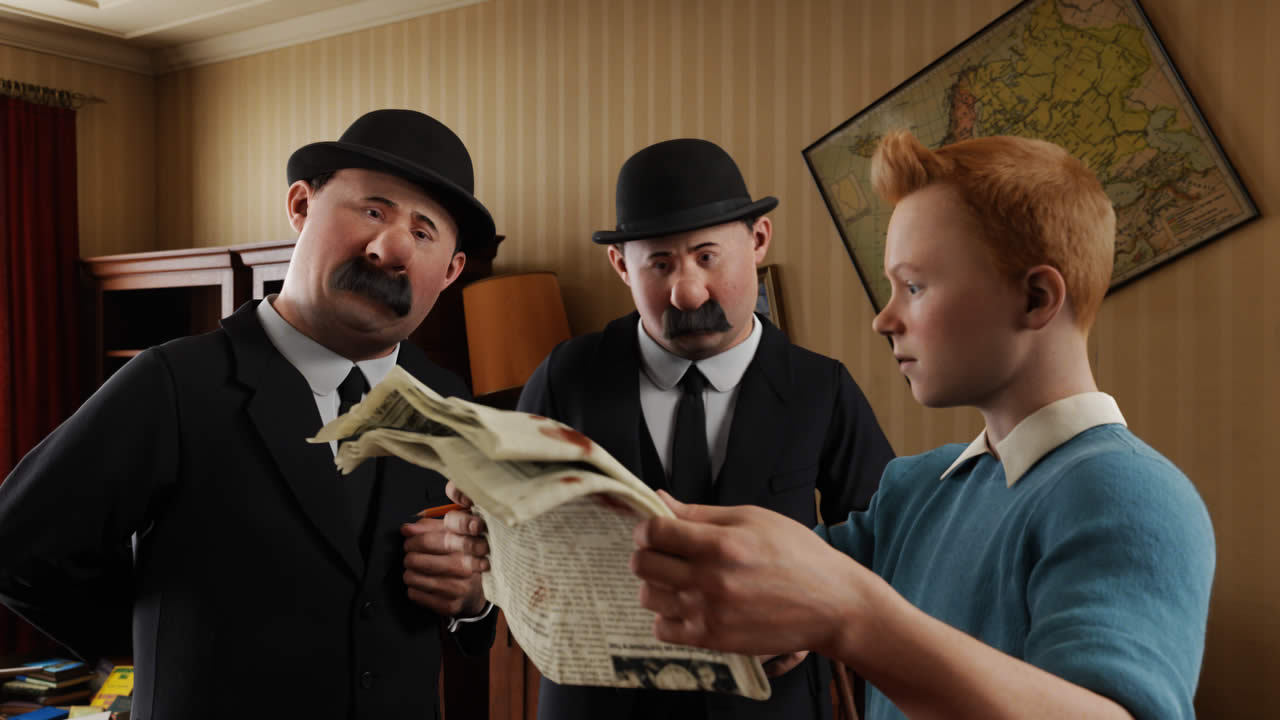
Steven Spielberg’s “Adventures of Tintin” may have the best animation style I’ve ever seen in a kids’ film. It’s almost as if you can’t tell if the characters are real people or art. It’s spectacular.
But I guess Spielberg was so focused on the animation, he forgot about half of the kid population. There are so many males and so few females in this movie that I– even me– was blown away. If a Martian came to Earth and saw this film, she would think our species was the type that clones itself to reproduce. The movie even has two twin mustachioed investigators that would seem to support that hypothesis.
Like most kids movies, this is a buddy movie (can I say “friendship” movie?) The three buddies, the main characters in the film– Tintin, Captain Haddock, and Snowy the dog– are male.
All the villains are also male, the gangs of them. The good guys are male as well, almost to caricature as mentioned with the clone investigators.
For female roles, there is a housekeeper, an old lady that hits someone with her bag, and a third who my daughter spotted when I went to the women’s room. My daughter said she was a singer.
I know, I know: Tintin was a book before it was a movie. What’s Spielberg supposed to do about that? He’s just one director trying to be faithful to his inspiration.
Tintin was actually many books, and “Adventures” ended with a teaser that practically announced the next film.
Reel Girl gives “The Adventures of Tintin” an SS rating. In spite of its almost total lack of females, Tintin escapes the dreaded Triple S. The females in the movie don’t do anything terribly, stereotypically offensive such as talk about their hair or their boyfriends, though they don’t interact with each other at all and one is a housekeeper.
Update:
After I posted about the lack of females in the new Tintin movie, a commenter wrote in this quote from Herge: “For me, women have nothing to do in a world like Tintin’s, which is the realm of male friendship.”
I googled the quote and all kinds of references came up, this one from Wikipedia:
Hergé has also been accused of sexism, due to the almost complete lack of female characters in his books. The only woman character of importance is Bianca Castafiore, who is potrayed to be foolish and nearly oblivious to all negative reactions to her behaviour — though she does show loyalty, presence of mind and quick wit when hiding Tintin and Haddock from Colonel Sponsz in The Calculus Affair.
Hergé himself denied being a misogynist, saying that “for me, women have nothing to do in a world like Tintin’s, which is the realm of male friendship”.[10]
Other reasons were because he believed that sentimentality had little to do in Tintin’s stories, which are mainly about men getting into all sorts of “misadventures rather than adventures”, and wherein “mocking women would not be nice”. He also felt that a man slipping on a banana skin, providing he does not break a leg, is much funnier than if it happened to a woman. As a female interviewer put it, “It has nothing to do with the misogynist world of the boy scout,”[11] referring to the fact that Hergé was a scout in his youth.
OK, Herge denied being a misogynist and then says “women have no place in a world like Tintin’s.” Um, that is misogyny.
Wikipedia tells us: “Tintin’s stories, which are mainly about men getting into all sorts of ‘misadventures rather than adventures’, and wherein ‘mocking women would not be nice.’ ”
Maybe that isn’t the full quote. Maybe it’s not in right context, but as it stands, Herge implies that the only reason to include women would be to mock them? Is there no other reason to include female characters in a story?
“Other reasons were because he believed that sentimentality had little to do in Tintin’s stories…”
So including women requires sentimentality?
And slipping on a banana peel is funny if you’re a man but not a woman? What?
I don’t get it. All the ways the Wikipedia writers and Herge attempt to explain away his sexism are sexist. What do they think sexism is? Maybe they excuse Herge for similar reasons that Reel Girl rated “Tintin” with two SSs for gender stereotyping instead of three; there weren’t blatant offensive acts in the movie, so the movie didn’t get the worst rating. Females aren’t “mocked” because of their gender, they’re just not there.
The sick thing is that when you see “Tintin,” when it comes to women, you can tell there’s something off in the mind of the creator. The lack of females is glaring and weird and disturbing. And this is a movie for kids! Doesn’t Stephen Spielberg care? Don’t parents? When Spielberg shopped this film around to studios (maybe Spielberg doesn’t do that) did anyone say, “Interesting story, but there are no females in the entire series. That might be a problem for us. Half of kids, after all, are girls.”
I guess no one said that. Sadly, Tintin” is actually not disturbing to audiences, because most of the movies made for kids today have casts pretty much identical to this one, a series created by an artist who believes women have no place in his imaginary world.
Update:
I got this comment on my Tintin post from Neal:
Funny, my wife, daughters, son and parents didn’t notice this absence. They saw a film they enjoyed. As a reader of the original series I can tell that you’ll be disheartened to learn that this absence continues. Stop badgering Spielberg about this. You should be congratulating Kathleen Kennedy who is one of the producers and a long time collaborator of Spielbergs.
If Neal went to a film where the three main characters were female, all the heroes and all the villains were also female, do you think he might notice?
Sexism is so ingrained, people use it to defend sexism. Wow.
Update:
Commenters are defending the Tintin movie, writing that creator Herge’s sexism was simply a product of his times.
Margot, you are aware that Hergé wrote most of his comic books (including the three on which the film is based) before WWII, at a time when women in his home country of Belgium as in many others didn’t even have the right to vote? Of course his work reflects the prejudices of that era, not only towards women but towards just about everyone who wasn’t a white Christian male (the most egregious example being Tintin in the Congo)!
Would Steven Spielberg adapt Herge’s racist views (“of his times”) expressed in Tintin in the Congoto make a movie in 2012 and market that movie to kids?
Of course not. No one would see it. People would be horrified. Herge’s racist views are universally recognized as the aberration that they are. Why is Herge’s “dated” sexism celebrated in a loyal adaptation from one of our most acclaimed directors?
There are two answers, both are true. The first one is that in 2012 sexism is, in many ways, just as accepted and “normal” as it was in 1932. Women are humiliated and degraded all the time, but while racism is seen as a political issue, sexism is still seen as a “cultural” one.
The second, less controversial explanation is that in Herge’s comics, he directly degrades and humiliates Africans whereas his sexism mostly manifests as an omission. His racism is worse. Herge believes women have no place in his imaginary world. Is that offensive? Is it even sexist?
It’s an annihilation.
What is remarkable about this annihilation, and what I was writing about, is that it’s consistent with the casts of most animated movies made today.A story originally created by an artist who spoke openly of how he didn’t think females should be included in his imaginary world is almost indistinguishable from the majority of films made for kids right now. Steven Spielberg probably didn’t even notice.
What does that say about how important we think girls are?
Steven Spielberg’s “Adventures of Tintin” may have the best animation style I’ve ever seen in a kids’ film. It’s almost as if you can’t tell if the characters are real people or art. It’s spectacular.
But I guess Spielberg was so focused on the animation, he forgot about half of the kid population. There are so many males and so few females in this movie that I– even me– was blown away. If a Martian came to Earth and saw this film, she would think our species was the type that clones itself to reproduce. The movie even has two twin mustachioed investigators that would seem to support that hypothesis.
Like most kids movies, this is a buddy movie (can I say “friendship” movie?) The three buddies, the main characters in the film– Tintin, Captain Haddock, and Snowy the dog– are male.
All the villains are also male, the gangs of them. The good guys are male as well, almost to caricature as mentioned with the clone investigators.
For female roles, there is a housekeeper, an old lady that hits someone with her bag, and a third who my daughter spotted when I went to the women’s room. My daughter said she was a singer.
I know, I know: Tintin was a book before it was a movie. What’s Spielberg supposed to do about that? He’s just one director trying to be faithful to his inspiration.
Tintin was actually many books, and “Adventures” ended with a teaser that practically announced the next film.
Reel Girl gives “The Adventures of Tintin” an SS rating. In spite of its almost total lack of females, Tintin escapes the dreaded Triple S. The females in the movie don’t do anything terribly, stereotypically offensive such as talk about their hair or their boyfriends, though they don’t interact with each other at all and one is a housekeeper.