My daughter teased for ‘boy’ shoes on soccer field

Today, during a soccer game, a kid on the opposing team made fun of my four year old daughter’s ‘boy’ shoes. I am so sick of this shit I could scream. It is crazy to me that people actually say, actually believe it’s “natural” for girls “want” pink stuff. My God, I’m honestly surprised my daughter has stuck with her Star Wars shoes for this long. As I’ve blogged, she isn’t even a big Star Wars fan, fighting for her passion with these shoes. She just bought a pair of shoes. I really feel like she could go either way, or one of many ways, pink and sparkly or action hero or something else, but everything out there is telling her which limited “choice” to make.

So after my daughter leaves the field, crying, which, by the way, I was totally bummed about. We’d rehearsed other responses, “I like my shoes” “There is no such thing as boy shoes,” so many times, but still, of course, I comforted her. I said I would talk to the girl. Her father, a nice guy, happened to be sitting right next to me. First, he called another kid over, asking her if she’d made fun of my daughter’s shoes. Both that kid and my daughter denied she was the one. Then the guy calls over his daughter who admits it was her, and my daughter seconds that. “I’m so sorry,” he said to me, after making his kid apologize. “I don’t know where she gets it.” I told him preschool, probably. And then he looks at his daughter and tells her: “Star Wars is cool. Star Wars has Princess Leia and she’s beautiful!”

Is that a bummer of a response or what? Here is a dad trying but totally missing the point. So I said, “And Leia is smart and brave and powerful, too.”

“Yeah,” says the dad.

How many times, do you think, in one day– from people telling them how pretty their dresses are or their hair or their shoes, to TV shows and books and movies and toys— little girls are shown that what they look like is the most important thing of all? What do you think they are learning to value most, their actions or their appearance? Where do you think they are learning to focus their efforts, concerns, and ambitions?

Here’s the video of my daughter talking about being bullied for ‘boy shoes made a couple months ago. Please share your stories so parents start to understand the epidemic that gender bullying has become, in preschool and beyond.

Thank you, Daisy Coleman, for telling us shame belongs to rapist, not survivor

The Maryville rape has taken a new turn with this post on xoJane:

I’m Daisy Coleman, The Teenager At The Center Of The Maryville Rape Media Storm, And This Is What Really Happened.

Thank you, Daisy Coleman, for telling your own story.

Please read Coleman’s story and share it. And then ask yourself, what happens when women tell the truth about their lives? How could the world change?

Whether a woman tells her story or not is her choice, but how much of a “choice” does she really have? I wrote “The shame of rape” on this topic for Salon. Ten years later, in too much media and public opinion, shame still goes to the wrong person.

When will we learn to honor rape survivors as the heroes that they are instead of shaming them into silence?

The “shame” of rape

The


When 7-year-old Erica Pratt was abducted on July 22 and tied up in a basement by her kidnapper, she chewed through the duct tape that covered her mouth, freed her hands and feet, and broke through a door to escape. Electrified by the young girl’s feat, the media celebrated Pratt with a prolonged blitz of coverage. She smiled luminously for cameras as awed police officers praised her bravery. Her photo graced the front pages of newspapers across the nation, and she was named Time magazine’s “Person of the Week.”

When Tamara Brooks and Jacqueline Marris were abducted at gunpoint nine days later from a remote teenage trysting spot in Lancaster, Calif., they devised a plan to break free by stabbing their abductor in the neck. When one girl had the chance to escape, she didn’t take it for fear that the other girl — whom she hadn’t met before that night — would be killed if she abandoned her. These were brave and loyal girls — heroines who endured mind-numbing terror before police found them and killed their captor, who authorities believe was preparing to murder them and dump their bodies.

But Brooks and Marris were not honored by Time magazine or identified as heroes in other media outlets. Why not? What made their story so different?

Just as newspapers and the networks were scrambling to cover the story, they learned that the girls had been sexually assaulted during their ordeal. Because most mainstream media observes a self-imposed policy of withholding the names and faces of sexual assault victims, the coverage abruptly, and somewhat awkwardly, ground to a halt.

Newspapers and TV broadcasters explained the shift as a matter of courtesy. But in concealing the identities of the young women on the grounds that rape is so intimate and horrendous that they should be spared undue attention, the media helped to promote the unspoken societal belief that somehow, when sexual assault is involved, the victim is partly — or wholly — to blame, and should be hidden from view.

TV stations began digitally obscuring the girls’ faces. Newspapers like the New York Times rushed to delete the names and photos of the girls from the next day’s paper. Some publications, like USA Today, had already gone to press, and printed the story with photos and names on the front page.


The lopsided coverage was especially disorienting because early in the story, the girls’ identities were broadcast everywhere — constantly — as a means of saving their lives. The idea was to familiarize as many Americans as possible with the girls’ names and faces so that average citizens might assist in tracking them, and their kidnapper, down. And it worked. But once the teens went from being kidnapped youths to rescued rape survivors, their status changed. They were branded with the Scarlet R. They had been raped. It was suddenly better for them, and us, to contemplate this shame without fanfare.

In effect, the girls disappeared twice — once when abducted, and again when the media erased them.

The policy of hiding the rape survivor makes the media complicit in shaming and stigmatizing her. It reinforces the myth that women are too weak, traumatized and tainted to decide whether they want to tell their own stories — of victory, not victimhood. And this assumption becomes a self-fulfilling prophecy. If raped women were granted the same status as Erica Pratt, there would be no reflex to make them disappear. Their survival would be cause for public honor and respect. Their rescues would be complete; their recovery would begin with heartfelt acceptance by everyone who prayed for their return.

Silence and shame protected the Catholic Church and one of its dirtiest secrets for years. And church officials made the right assumption: If you can’t see it, no one will believe it is happening and, more importantly, victims who are shamed and controlled will be quiet, silenced by a sense of complicity and sin. What if all those alleged male sexual assault survivors who went on “60 Minutes” and “20/20″ had their faces covered with a gray dot? What if no newspapers or magazines had been willing to publish their names? How much credibility or validity or power can you have when you have no face and no name? Would the public have believed these things had happened if faces had not been attached to the charges?

You can’t put a faceless woman on the cover of Time magazine.

Not all rape survivors take the media’s cue and withdraw. Many have told their stories as part of their recovery, most famously authors like Maya Angelou in “I Know Why the Caged Bird Sings” and Dorothy Allison (“Bastard Out of Carolina”), and singers including Fiona Apple and Tori Amos. Current bestselling author Alice Sebold has said repeatedly in interviews that she could not have written “The Lovely Bones” until she wrote the story of her rape in her first book, “Lucky.”

With each of these acts of bravery has come further acknowledgment that rape is a horrible event and that everyone abhors it, yet hypocrisy — public and institutional — still exists. Rapists are rarely successfully prosecuted. For every 100 rapes reported in this country, only five rapists end up in prison. Sentences are relatively light, averaging just 10.5 years, and the usual time served is approximately five years.

U.S. Attorney General John Ashcroft doesn’t support the notion that a raped woman should have the right to an abortion. And U.S. foreign policy does not include sanctions, even strongly stated warnings, against countries like Saudi Arabia where men are allowed to rape their wives, and married women raped by men other than their spouses are punished for adultery. In Pakistan, when a young woman was ordered raped by a tribal council as punishment when her brother was seen in public with a woman not in his family, the U.S. State Department took no action.

At the same time that it is no longer socially acceptable to blame or stigmatize a rape survivor for what has happened to her, it appears to be socially unacceptable to recognize her as a hero and honor her for survival. But that may be about to change, thanks, in large part, to Marris and Brooks, two rape survivors who demanded to be seen.

A day after she was rescued and her identity had been quickly masked in the media, Marris appeared on KABC, the local Los Angeles news station, to talk frankly, without embarrassment, about her ordeal. She revealed, among other details, the fact that she and Brooks had tried to escape by stabbing their abductor in the neck.

A few days later, Brooks and Marris both appeared on the “Today” show to tell the story of their capture and captivity, a gripping account in which they described being threatened with a loaded gun, smashing their abductor in the face with a whiskey bottle, and later watching him die.

When asked why they chose to talk about their experience, Brooks said that she wanted to do it, and came forward with the support of her parents, who braved some criticism about the decision. She and Marris, Brooks said, “want to get the message across to everybody to never give up on anything. If you ever give up, you’ve lost. Whatever obstacles you have, you’ve got to fight your way through it.”


Mom writes teacher about gender bias in homework

Ever noticed your children’s homework shows boys playing sports while girls bake cookies? It drives me bats. I’m so happy that mom, Elizabeth Mandel, wrote a letter to her child’s teacher about gender bias in homework. All of us should do this. Here’s part of her letter:


My daughter is absolutely thriving in your classroom. As you know, she has a particular affinity for math, and she adores doing math homework (I hope she feels like this about homework forever).


While sitting with her while she was doing her math homework tonight, I noticed that in the examples, Shawn and Mike have robots and baseballs, while Lucy makes sandwiches for her friends. As I mentioned when we met last month, I am very invested in keeping my daughters, and all girls, interested in STEM subjects, and in diminishing the subtle cues that contribute to the gender gap in all areas. I strongly feel, and I am supported by research that shows, that subtle cues that assign boys certain interests and girls certain interests are absorbed by young children and impact how they see their roles in the classroom and in society at large.

Thank you, Elizabeth, for this letter. Thank you to Pigtail Pals for posting it. You can read the rest of the letter and information about the teacher’s reply on Pigtail Pals Facebook page.

New evidence shows early women were artists and warriors

All week, I’ve been trying to get a minute to blog about new evidence showing the earliest artists were women. From NBC News:

Alongside drawings of bison and horses, the first painters left clues to their identity on the stone walls of caves, blowing red-brown paint through rough tubes and stenciling outlines of their palms. New analysis of ancient handprints in France and Spain suggests that most of those early artists were women.


This is a surprise, since most archaeologists have assumed it was men who had been making the cave art. One interpretation is that early humans painted animals to influence the presence and fate of real animals that they’d find on their hunt, and it’s widely accepted that it was the men who found and killed dinner.


But a new study indicates that the majority of handprints found near cave art were made by women, based on their overall size and relative lengths of their fingers.

“The assumption that most people made was it had something to do with hunting magic,” Penn State archaeologist Dean Snow, who has been scrutinizing hand prints for a decade, told NBC News. The new work challenges the theory that it was mostly men, who hunted, that made those first creative marks.


Another reason we thought it was men all along? Male archeologists from modern society where gender roles are rigid and well-defined — they found the art. “[M]ale archaeologists were doing the work,” Snow said, and it’s possible that “had something to do with it.”

What, rigid gender roles now, in 2013? But I thought were we beyond all that, living in a post-feminist world and all. Here are some stats on women artists today:

stats

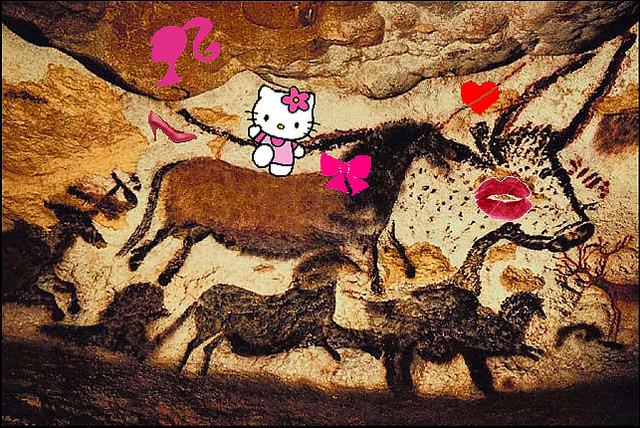
Want to see something else fucked up? Looking for this story, I typed “cavewomen artists” into Google. Here’s the first match I got.cavewomen

A pink bow, are you kidding me? Looks like Disney has been here or perhaps, just Hollywood.

Think gender bias is restricted to archeology “experts”? Here’s another story from NBC News

Last month, archaeologists announced a stunning find: a completely sealed tomb cut into the rock in Tuscany, Italy. The untouched tomb held what looked like the body of an Etruscan prince holding a spear, along with the ashes of his wife. Several news outlets reported on the discovery of the 2,600-year-old warrior prince.


But the grave held one more surprise. A bone analysis has revealed the warrior prince was actually a princess…The mix-up highlights just how easily both modern and old biases can color the interpretation of ancient graves.


I see these two stories as related, showing how gender bias today influences how we interpret at the past. It’s funny because I’ve heard a lot from others that I look at the world through a feminist lens, but what if it’s not me wearing the funny glasses?

 Update: Commenter says pic is satirical (like the first) in which case, I like it. Maybe it’s saying, “Is this the proof archeologists are looking for to attribute work to women?”

Apparently, I need an animator

Look what ad just showed up on my Facebook feed.


Is your face sending mixed messages? It could be. Your “resting face” may make you seem angry, grumpy or unapproachable to others. This may affect both your private and public lives.So what can be done about this problem?Injectable cosmetics can also help women who look grumpy when they are at peace. Botox injections can smooth worry lines between the eyes and raise the eyebrows. Dermal fillers an round out the chin and mouth or fill in deep creases that make you look upset.If you don’t like the way your face looks when you are at rest, you may want to ask Dr. Kulick for advice. He will be able to point you in the direction of aesthetic procedures that could help alleviate this problem:
Is your face sending mixed messages? It could be. Your "resting face" may make you seem angry, grumpy or unapproachable to others. This may affect both your private and public lives.</p><br /><br /><br /><br /><br /><br /><br />
<p>So what can be done about this problem?</p><br /><br /><br /><br /><br /><br /><br />
<p>Injectable cosmetics can also help women who look grumpy when they are at peace. Botox injections can smooth worry lines between the eyes and raise the eyebrows. Dermal fillers an round out the chin and mouth or fill in deep creases that make you look upset.</p><br /><br /><br /><br /><br /><br /><br />
<p>If you don't like the way your face looks when you are at rest, you may want to ask Dr. Kulick for advice. He will be able to point you in the direction of aesthetic procedures that could help alleviate this problem: http://bit.ly/1e337x4</p><br /><br /><br /><br /><br /><br /><br />
<p>F
Can’t I just get a Disney animator to fix my image up? Who needs facial expressions anyway? Oh, that’s right, men do.
The Society Pages posts the PR for “The Counselor.”
Screenshot_114
Screenshot_27
 The men are not considered unattractive by virtue of the fact that you can tell they have skin.  The women, in contrast, have faces that are so smooth that they look inhuman; their images are halfway between photograph and cartoon.  Amazingly, this treatment of images of men and women is so ubiquitous that it now looks more or less normal to us.
Fantasy creates reality and reality creates fantasy in an endless loop.

Art teacher for kids says ‘almost without fail, girls create male characters’

Lori comments on Reel Gir’s post Speaking of art as derivative:

I teach clay classes for kids, and we often do character sculptures. I encourage the kids to create characters and make up stories about them, and almost without fail, the girls will create male characters. If they do make female characters, they always have long hair, a dress, and big eyelashes, and are defined by how pretty they are, or some romantic plot point. Any monsters or animals were male by default. I actually ended up running a couple of workshops specifically aimed at girls to encourage them to create stories about female protagonists, and to talk about gender stereotypes in storytelling because of this. It’s so pervasive, they don’t even realize they’re doing it, or that they are free to create anything different.


This makes me so sad about the limits gender bias in our culture is putting on children’s imaginations. Lino DiSalvo and co, do you see the problem now? What are you going to do about it?

Cloudy With Little Chance of Girls Starring In Animated Movies

Yesterday, I took my three daughters ages 4, 7, and 10, to see “Cloudy With a Chance of Meatballs 2.” We all enjoyed the movie. The animation was great, though the story was a little weak. I didn’t really understand why the evil guy had to do his evil deeds. But here’s the real problem with the movie. Here are the main characters:

Cloudy-With-a-Chance-of-Meatballs-2

There are 5 males and 2 females. The female ape, Barb, is the sidekick to the evil villain and the female human, Sam Sparks, is the sidekick for the hero. Sam is a classic Minority Feisty. She is a great character, smart, compassionate, and brave. She’s a scientist. But her role in the movie is to support the hero.

The last 6 movies I’ve seen with my daughters– “Despicable Me,” “Monsters Inc,” “Smurfs 2,” “Percy Jackson and the Sea of Monsters” “Turbo” and “Planes, all reviewed on Reel Girl, have the same pathetic gender ratio.

Females are half of the kid population so why are they conistently presented as a minority in movies made for children?

See Reel Girls’ Gallery of Girls Gone Missing From Children’s Movies in 2013


Speaking of art as derivative…

My daughter, inspired by the movie, “Soul Surfer”  about champion Bethany Hamilton, made this:

bethanyart

Why do you think so many little girls make art about pretty girls in pretty dresses? Because that’s just “natural”?

Last Spring, when another daughter of mine was 3 years old, she made made a magical creature called a flying Brachiosaurus.

creature

Here’s what she said to her teacher about it:

This is its little wings for going to tree because it has to. These are horns to help him pick up people. He steps on giant people. He flies on mountains or houses and it doesn’t break.

Why do you think her creature is male? I looked at the other children’s art work in her class, half of them girls. Every picture I saw described a male creature.

When another daughter was asked to write a story during school in third grade, she used a male protagonist. When I asked her why she chose a male, she said, “Because everybody did.”

Can you imagine if in a class of third graders, every kid wrote about about female protagonists? Do you think the teacher would notice?

Here is that daughter’s drawing of Harry Potter. This is the same daughter who later drew Bethany Hamilton.

harry

This scene didn’t happen in the book but she was inspired by the book. Her drawing shows a typical gender matrix you see all over children’s media: 2 boys, 1 girl; boy in front, girl behind; text supports male competition and victory.

Here is a picture my middle daughter drew at age 6 while I was reading her the first part of the first Harry Potter.

witchphoto

She made up this character, a witch and her cat soaring through the sky on a broom surrounded by many crescent moons. I was pretty psyched about this witch, but then again, we were only at the beginning of Book 1. Would she still make a female character, front and center, after Book 7?

Here is a make-a-plate my older sister made when she was a kid and obsessed with fairytales.

kim

It’s fascinating to me how much care she took to represent ethnic diversity in these women. Also, their faces are so animated, even though they’re dead. I was impressed but grossed out and disturbed when my sister drew this. She wanted to know which one I thought was the prettiest.

I sought out “Soul Surfer” for my daughters, because I’m always on the look out for images and narratives about heroic females to inspire them. That’s why I started this blog, as a place to collect stories and pictures. But unfortunately, these kinds of depictions of women and girls are far too rare in kidworld, not to mention the grown-up one.

What happens to the imagination of children, and the adults they become, when we live in in a world where heroic girls go missing?


But not all female artists are feminists?

After I posted asking what the world would be like if we hadn’t been experiencing it through male artists for thousands of years, commenters respond that not all women are feminists. I agree, absolutely, and many men are feminists. Also, art is derivative, responding to what came before, as Marian writes:

women artists (and writers) being capable of playing into negative gender stereotypes. Even feminist artists, often in unexpected and subtle ways. We’ve all been conditioned and it’s very hard to get beyond it, consistently.

Very true and makes me think of Gloria Steinem’s comment on Miley Cyrus:

“I wish we didn’t have to be nude to be noticed … But given the game as it exists, women make decisions. For instance, the Miss America contest is in all of its states … the single greatest source of scholarship money for women in the United States. If a contest based only on appearance was the single greatest source of scholarship money for men, we would be saying, “This is why China wins.” You know? It’s ridiculous. But that’s the way the culture is. I think that we need to change the culture, not blame the people that are playing the only game that exists.”

I doubt the world will ever be dominated by the vision of one group the way it has been for so long by white men. But what I was imagining in my post is: what if our worldview had always been dominated by women as a group, the way it has been dominated by men? Men’s roles in narratives would repetitively show up as lovers, sex objects, prizes to win after a quest. When we don’t have diversity, we get stereotypes.

Women, just like men, come in all shapes and sizes. The problem is, right now, we are allowed to exist only within extremely limited parameters. Why animation fascinates me is that it’s a clear intersection of art and story, and also, a fantasy world where anything is possible, marketed to children. It’s clear to see how sexism is packaged, recycled, and sold to a new generation. Or at least, clear to me.


What happens when we experience the world through male artists?

Animator and I are in a debate which I just blogged about, and in response, he sent me a link to to a post about Joanna Quinn, one of the top animators in Europe.

Joanna_Quinn_animation_Lg-fmt-462x279

Here’s Quinn’s quote in response to DiSalvo’s comment:

It’s not at all hard to draw women showing emotions. The only challenge is the notion of beauty. It’s really hard to inject lots of emotion because you’re always trying to keep them [as] this sort of shiny, lovely character. I am looking for strong female characters that are not always gorgeous.


So there’s yet another established artist referring to the need for female characters to be pretty.

joannaquinn-women

As I so often do on this blog, I ask again: What is “pretty”? For a male protagonist, his attractiveness is often determined in a narrative by his actions. Rescuing someone, risking pursuing a dream, brilliance, talent, excelling at a sport or at a skill, is all attractive. While for a female character, her “attractiveness” is usually primarily determined by how well her appearance fits into a limited definition of physical beauty.

joannaquinn

Animator directed me to Joanna Quinn’s site, writing that I would enjoy her work. I do! Please check it out, and think about what our world would look like if female artists dominated our cultural imaginary the way male artists do. How differently would we see women and how differently would we see men? For thousands of years, females have been limited to supporting roles in stories that star men. Don’t you think it’s about time for that to change? At least, for our kids?