These career Barbies are so stupid. The last thing you notice from the picture is what profession they are supposedly involved in, especially if you’re an illiterate kid. What you do see is flowing blonde hair, blue eyes, and a skinny body. If you want to teach kids to DO something, give them a toy that does stuff. I recently listened to a panel of women architects talk about the newly released Architect Barbie. Those professionals didn’t like the doll, telling the audience that if they want their kids to grow up to be architects buy them blocks and Legos. So much for Legos which has recently soared to new heights with its sexist marketing, but blocks are still a good option.
What do you get if you’re a boy with your Happy Meal? Oh, Hot Wheels.
“Get ready for the release of January’s McDonald’sHappy Meal toys sets one geared to little boys and one for little girls. Team Hot Wheels set has 8 different types of vehicles from mini monster wheels to race cars.”
This makes me so sad about my two-year old daughter who loves cars right now. But I know, very soon, with all this marketing, she’ll start to go for the Barbies if I’m not super counteractive with this relentless gender marketing. UGH. One more reason not to go to McDonalds. Wow, so much money money and effort by huge companies doing their best to stereotype little kids.
Another social media victory! Thank you to all who spoke out and signed the petition. Here’s to hoping LEGO becomes a leader in inspiring both genders to dream big.
From Change.org:
After a month and more than 50,000 petition signatures, an open letter, numerous radio shows, TV segments, blog posts, articles, and even YouTube videos about the company, LEGO has decided to listen to girls! On Sunday, February 5, Michael McNally, Brand Relations Director, sent an email to SPARK Movement. SPARK, a girl-fueled movement to end the sexualization of girls, is a coalition of more than 70 organizations and reaches tens of thousands of girls and those who support their healthy development. LEGO has accepted SPARK’s request for a meeting to discuss how they can go back to offering all LEGO toys to both boys and girls and to respect girls’ hunger and desire to play with toys that challenge them creatively and intellectually.
Parents, please: enough with the “we’re just giving kids what they want.” Children learn through play. Segregated toys are inhibiting kids’ brain development by severely limiting their experiences. Children’s brains have more plasticity than at any other time in life, that’s why they can learn languages rapidly. Once those synapses make connections or shut down, its harder for brains to grow later. Read more about all that here. And here. And here.
What can you do? Resist marketing. It’s messing with your kid’s brain. You are the parent. You’re the shopper, the one with the wallet. Buy wisely.
How?
Get your daughters out of the monochromatic world of pink. Or any monochromatic world. Your kid may resist. This may be a challenge for her because kids love routine. But, still, challenge your kid with toy choice the way you would with any other learning activity. Help them to branch out and encourage them to try new things. Get excited about the toy. Play with it with them. Most of all, they want your attention.
Schedule play dates with kids of the opposite sex. If your kid’s preschool tends to segregate by gender, or allows them to self-segregate, talk to teachers and the head of school about mixing it up. Kids learn when they move out of their comfort zone.
Read your sons books where the main characters are girls.
Show your sons and daughters animation where the main characters are female (Miyazaki is a great choice.) After we all see “Tintin” or “Lord of the Rings” or “Arthur Christmas” on the screen, the posters all over town, and then the video games that follow and the toys derived from the movies, all practically without females, it seems normal that there are so few girls represented everywhere except for the pink ghetto. The annihilation of girls passes us by unnoticed. Girls are half of the kid population, yet children’s movies today normalize an imaginary reality where females hardly exist at all. Then we all literally buy into it. How do you think that makes girls feel? What does it make kids think? What are kids learning about which gender is more important?
Let stores and toy companies know how you feel about their relentless drive to segment toys by gender in order to sell products. Write to the companies directly. Blog about them. Tell your friends about it on Facebook.
We are SPARKing this movement armed with Post-It notes and cameras in the blue and pink aisles. (Seriously, some stores have actually have colored their toy aisles pink and blue! When will it end?) With your Post-Its, make a note using slogans like “Where My Girls At?” in the blue aisle, “Your Girl Needs Joe, too” on a GI Joe, “This Is An Option For Everybody” and “What About Dads?” on the baby dolls.
SPARK advises to use statistics:
women make up only 13% of architects (I wonder why LEGO?), 14% of active US military (Where is G.I. Jane?), and 4% of executive chefs — so, why are all the kitchen gadgets pink when so many chefs are men?
I’ve thought about these kinds of stats a lot, and it comes down to this: if it’s low status, its assigned as “feminine” (cooking), and women dominate; but if its high status, all of a sudden it becomes “masculine” (being a chef) and men dominate. This bait and switch applies to the whole stereotype that boys like action while girls are more literary, good with words, and artsy. Unless we’re talking about the Pulitzer Prize or the latest exhibition at the MOMA, in which case, all of a sudden men rule the roost.
A department store in London, Hamley’s, decided to break out of the current trend and organize its toys by toy type instead of by the gender of the kid: arts and crafts, building toys, outdoor toys etc. Congrats to Hamley’s. Let’s hope the land of the free and the brave and its Targets and Walmarts learn something. In the meantime, parents need to shop carefully.
So in response to my last post, one commenter wrote that LEGO never said tossing the girlfigs out was OK, LEGO simply “observed” the behavior. I love this comment in response, so I’m sending it to you all:
LEGO is indeed saying that it is okay. Not just okay, but super, super okay. So okay, that LEGO would toss out the girl figs themselves so that the boys wouldn’t have to be inconvenienced to do so.
We found that little girls really enjoyed having male and female minifigures in their sets, while the little boys would take the girl minifigure out before playing.
Why does LEGO think it’s OK for boys to throw the girl figs aside? And that girls are just thrilled to play with male figs? And that’s “natural?” Seriously. What kind of “researcher” observes that behavior and decides to create a toy that segregates genders even more dramatically? Don’t they get that that’s the problem? Or maybe they just don’t care about behavior that should be noted as curious because it fits easily into the whole idea and practice of segmenting the market in order to move products.
The conclusions LEGO came to, stereotyping girls even more extremely, sounds strikingly similar to Disney male exces claiming that girls will see movies about boys but boys won’t see movies about girls. Could that preference have anything to do with the ridiculous limited roles girls have in movies? Look at just the latest one, “The Lorax,” where the female character is the “romantic interest” of the main character, a male. This is an animated movie for kids. Romance? How do you think girls feel watching themselves, again and again, in smaller roles than boys? Less represented than males? Do you think, possibly, they might learn to put a lot of attention into what they look like, the way girls in movies and LEGO sets do, and what boys think about them, not because that’s “natural” but because that’s how they get any part at all in the show?
Callie, a ten year old girl, wrote to LEGO. She was upset about the sexism of LEGO’s new Friends sets created “for girls.” Callie wrote a beautiful, well thought out letter. Her mom emailed Callie’s letter and LEGO’s unbelievably dimwitted, impersonal response to Melissa Wardy of Pigtail Pals.
Here’s how Callie’s letter begins:
Rosalind Elsie Franklin, Lise Meitner, and Grace Murray Hopper. Do you think those great women scientists spent time playing with vintage style dressing rooms when they were girls? Do you think they decided to sit and look at a girl brushing her hair? No. They would be walking in museums, reading, conducting experiments, researching, and doing creative thinking. Legos are a great way to do the latter and I congratulate you on that. Legos are amazing and a great idea. They’re fun, brain building and easy to use. But when you turn them into a stereotypical toy, that’s just destroying the individuality so many people have been working for. Martin Luther King Jr. fought for blacks and whites to be equal. Today people are fighting for the equality of gay people. Susan B. Anthony and Gloria Steinem were fighting for women’s equality. And when I walk into a toy store and an attendant leads me to an aisle plastered with putrid pink I think you just swept all those people fighting for equality out of the way and ignored what they said.
Here is part of LEGOs response:
We found that little girls really enjoyed having male and female minifigures in their sets, while the little boys would take the girl minifigure out before playing. Boys tend to like to create “good guy versus bad guy” types of scenes, while girls enjoy role play, such as going shopping with their minifigures.
LEGO, do you think boys might take out the girls because they’ve been conditioned to? Because they rarely see females in kids’ media doing anything adventurous or fun at all? Do you even read what you write: good guy versus bad guy? You know what tools help to act that out? Good guys and bad guys. Please take a look at your own minifigs. What about your brand new sets coming out in 2012: Lord of the Rings and Superheroes? How many females compared to males are included in those sets? (If you’re going to complain that this sexism is not LEGO’s fault but J.R.R. Tolkien’s or Hollywood’s or DC Comics, please read this post: When Hollywood excludes girls, how can LEGO market to them?)
That good/ bad duality you’re writing to Callie about? It’s not a boy thing. It’s a human thing. It’s also “role play” by the way. (What do you think role play is?) And shopping– that would be a cultural phenomenon. Not innate. LEGO, do you honestly believe that girls are born loving to shop? REALLY?
It’s so great that, as an educational toy and all, LEGO has decided to finally allow females into front and center roles by creating sets with girls baking cupcakes, drinking cocktails in hot tubs, and going to the beauty shop. (See LEGO’s TV ad for the Friends sets here.)
To sign the petition against LEGO “for girls” on Change.org started by Powered by Girl and SPARK please click here. So far, this petition has gathered over 50,000 signatures but no response from LEGO when PBG and SPARK sent a letter (which I signed as well, you can read it here) with the petition enclosed, requesting a meeting to discuss the concerns of unhappy customers. Just yesterday, SPARK sent LEGO a second letter by certified mail requesting a response by February 6. It seems strange that LEGO would ignore 50,000 customers after spending four years “researching” what girls want.
Rosalind Elsie Franklin, Lise Meitner, and Grace Murray Hopper. Do you think those great women scientists spent time playing with vintage style dressing rooms when they were girls? Do you think they decided to sit and look at a girl brushing her hair? No. They would be walking in museums, reading, conducting experiments, researching, and doing creative thinking. Legos are a great way to do the latter and I congratulate you on that. Legos are amazing and a great idea. They’re fun, brain building and easy to use. But when you turn them into a stereotypical toy, that’s just destroying the individuality so many people have been working for. Martin Luther King Jr. fought for blacks and whites to be equal. Today people are fighting for the equality of gay people. Susan B. Anthony and Gloria Steinem were fighting for women’s equality. And when I walk into a toy store and an attendant leads me to an aisle plastered with putrid pink I think you just swept all those people fighting for equality out of the way and ignored what they said.
Generalizing is saying any group of people is all one way, or likes one thing. Even if it’s complimentary, saying a group of people is all the same is just not true. Every person is unique and has a spark, different likes and dislikes, and faults of their own. You must respect that.
There are plenty of smart and creative girls out there eager to play with Legos. Do you want that to be ruined, by giving them only a beauty salon to create? Please don’t. But I’m not proclaiming you should stop making those products, because they make generalizations about girls. But why just give us one option? There are plenty of girls ready to play with your ‘girl’s’ Legos. Plenty eager to pretend to comb hair and such. But then the girls who want superhero toys or adventure toys or dinosaurs or space toys or Harry Potter toys or Egyptian toys are forced to go to the boy’s aisle. They shouldn’t have to do that. Are you saying toys they want are for boys only? It’s not right to make a girl feel like she’s not acting like a girl should or is different. Are boys the only people who can do constructive things? No! But forcing a girl to go to the boy’s aisle, making her feel like she shouldn’t use Legos that aren’t pink and girly is just plain stupid. Why don’t you even have a boy’s category on your website? Are you saying boys can play with everything they want, unlike girls who have pink beauty salons? You have a girl science lab Lego set, yet it’s still pink and calls the things included “accessories”. The other themes, such as Ninjago call them staffs, or weapons. So even girl science lab appliances are called the same girly thing as jewelry. Why do that? To make money? That really makes me feel so much better about the world I live in.
And there’s another thing that makes me more secure about today’s lifestyle. If the girl does go to the boy’s aisle what meets her eyes is the sight of war. Legos you can use that create a war scene, or spies shooting at each other or a spaceship with guns to shoot aliens. Does this seem right? Do we need more war in our bloodstained world? It gives kids the idea that war is funny or nothing to be worried about. Movies surround us with people fighting each other with powers and guns. Little boys like my cousin see people getting blown up, but then just singed or bouncing. Getting hit with lasers and just looking wounded but then reviving quickly or pretending to be dead than sneaking up on the bad guy because they missed. This isn’t real life. Many people have died in war, families torn apart, torturings of innocent people and betrayal driven by fear. This is war. Children need to understand that.
You say, ‘I’m just making a living. The kids like it, it’s not your fault the world isn’t perfect and they don’t understand it. Or that some girls feel like they’re weird or that they should be making beauty salons instead of whatever they feel like.’ But it is in a way. You’re just a piece of the fault. You are a part of that thought growing in a kid’s mind about how they should be and what to think. Make it be the right idea. Please. Make a kid’s world a little less narrow-minded and stereotypical. Make some of it right.
Callie W., age 10
~~~~~~~~~~~~~~~~~~~~~~~~~~~~~~~~~~~~~~~~~~~
Lego’s response, about two weeks following Callie’s Letter:
Dear Callie,
Thank you for writing to us with your concerns about the design of our LEGO (R) Friends product line.
We listened very carefully to what girls around the world told us in four years of concept development for LEGO Friends: and we’ve used their input to create a theme that invites girl who appreciate these qualities to the LEGO building experience.
Many girls told us they had trouble identifying with the LEGO minifigure’s unrealistic appearance. As role play is central to the LEGO Friends experience we designed a figure with a more realistic appearance. While we understand that this theme is out of the norm for LEGO as, like you said, we are a gender neutral company. We feel it’s a step in the right direction to get girls more involved with LEGO products. Sadly, over the year, many of our girl fans have diminished and moved onto toys that appeal to them. For this reason, we decided to conduct studies with children in this age group. We found that little girls really enjoyed having male and female minifigures in their sets, while the little boys would take the girl minifigure out before playing. Boys tend to like to create “good guy versus bay guy” types of scenes, while girls enjoy role play, such as going shopping with their minifigures.
If you would like, Callie, you can take a look at our recent official press release in regards to our new Friends line. It may be something that you’re interested in. If you visit Aboutus.LEGO.com and click on Press Room and then Corporate News, you will be able to view our recent press release. I hope that this is of interest to you.
We appreciate you taking the time to share you thoughts and concerns with us. Listening to what our fans have to say helps us improve our current and future products, so I’ve passed your comments on to our design team.
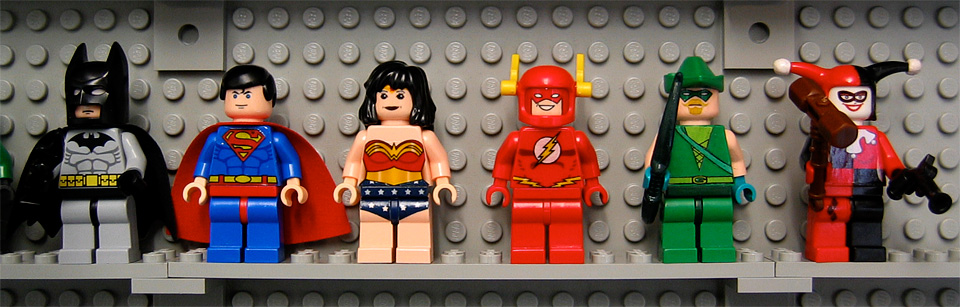
How is a girl going to feel when she looks at this set? Included? Important? Like she exists at all?
So because of this “boys only” or “mostly boys only” rules of LEGO sets like this one and the new superheroes sets, LEGO comes up with the sexist Friends? Apparently, if girls get to play, they must participate in stereotype.
The rumors are true! We are teaming up with DC Comics and Marvel to bring new super hero sets including characters like Batman, Superman, Iron Man, The Hulk, and many others! What hero are you most excited for?
On bricksuperheroes.com, you can see also see photos of Green Lantern, the Joker, Nightwing, Lex Luthor. Superhero sets also include: Robin, the Riddler, Killer, Mr. Freeze, Scarecrow, Bruce Wayne, Mr. Freeze’s Henchman, Bane and Twoface. The females I can find are Wonder Woman, Catwoman, Harley Quinn, Poison Ivy, and Hawkgirl. That’s 17 male characters to 5 female ones. Please let me know if you find anymore!
At least there are 5 females, and I would advocate buying these for your kids, but I am so annoyed with LEGO for its hyper-sexist Friends sets that I can’t support this company.
In recent years, child development experts, parents, and scientists have been sounding an increasingly urgent alarm about the decreasing amount of time that children – and adults, for that matter – spend playing. A combination of social forces, from a No Child Left Behind focus on test scores to the push for children to get ahead with programmed extracurricular activities, leaves less time for the roughhousing, fantasizing, and pretend worlds advocates say are crucial for development.
So what happens when kids’ toys and media– major tools for fantasy play– increasingly focus on perpetuating limited gender stereotypes? Unlike in the past, TV series and movies today are often created around products in hope of moving merchandise. The Christian Science Monitor reports:
In the early 1980s, the federal government deregulated children’s advertising, allowing TV shows to essentially become half-hour-long advertisements for toys such as Power Rangers, My Little Ponies, and Teenage Mutant Ninja Turtles. Levin says that’s when children’s play changed. They wanted specific toys, to use them in the specific way that the toys appeared on TV.
Even Lego’s Friends toys eagerly promises movies and games to accompany the sexist sets.
Lego now has a Lego Club Girls Magazine, which according to a mom whose kids are members, is the only place where Lego will feature pictures that girls send in of themselves with their “builds.” They no longer plan to put pictures of girls in their other magazine, which is both the defacto “boy magazine,” but will continue to be called the Lego Club Jr. Magazine. This segregates girls’ play. Boys should see girls building, and girls should see boys building. For boys, the one place where they might have previously seen girls in official Lego marketing, is now a boys-only space.
Tell me what you know.
Update: From the comments I’ve gotten here and on FB, it seems to me– and this is a guess– that Lego is in the process of deciding, Look at the comments and see what you think. Here is the comment I got back from LEGO on its FB page:
FROM LEGO: Hi Reel Girl! The pages in the magazines displaying children’s builds will feature pictures from girls and boys in both magazines. Thanks for clarifying with us! 🙂
I left LEGO more questions clarifying the clarifying. Will there be girls in Lego Jr Club? Why 2 magazines? Are you going for pretty much equal representation of genders in each or is your goal to primarily have boys reading one and girls reading the other?

 What do you get if you’re a boy with your Happy Meal? Oh, Hot Wheels.
 , she’ll start to go for the Barbies if I’m not super counteractive with this relentless gender marketing. UGH. One more reason not to go to McDonalds. Wow, so much money money and effort by huge companies doing their best to stereotype little kids.