Winners Never Quit


This book is by famed soccer player, Mia Hamm. It’s about her childhood when she spent her days playing soccer with her family. “Tap, tap, tap. Her toes kept the ball exactly where she wanted it. She’d kick the ball straight into the net. Goal! Everybody on her team would cheer.”

But then Mia has a bad day, and she doesn’t score any goals; there’s no cheering for her. Her older brother puts his arm arund her and says, “Better luck next time.” But Mia says “I quit,” and storms off the field.

The next day when she shows up to play, her brother won’t let her. “Sorry, Mia. Quitters can’t play on my team.” Mia is forced on the sidelines, just watching. The next day she is allowed to play again, and when she doesn’t make the goal “she feels tears in her eyes.” She hears whispering that she’s going to quit, but she realizes she loves playing soccer even more than she hates losing, and she keeps playing. “Maybe she’d score a goal, maybe she wouldn’t.”
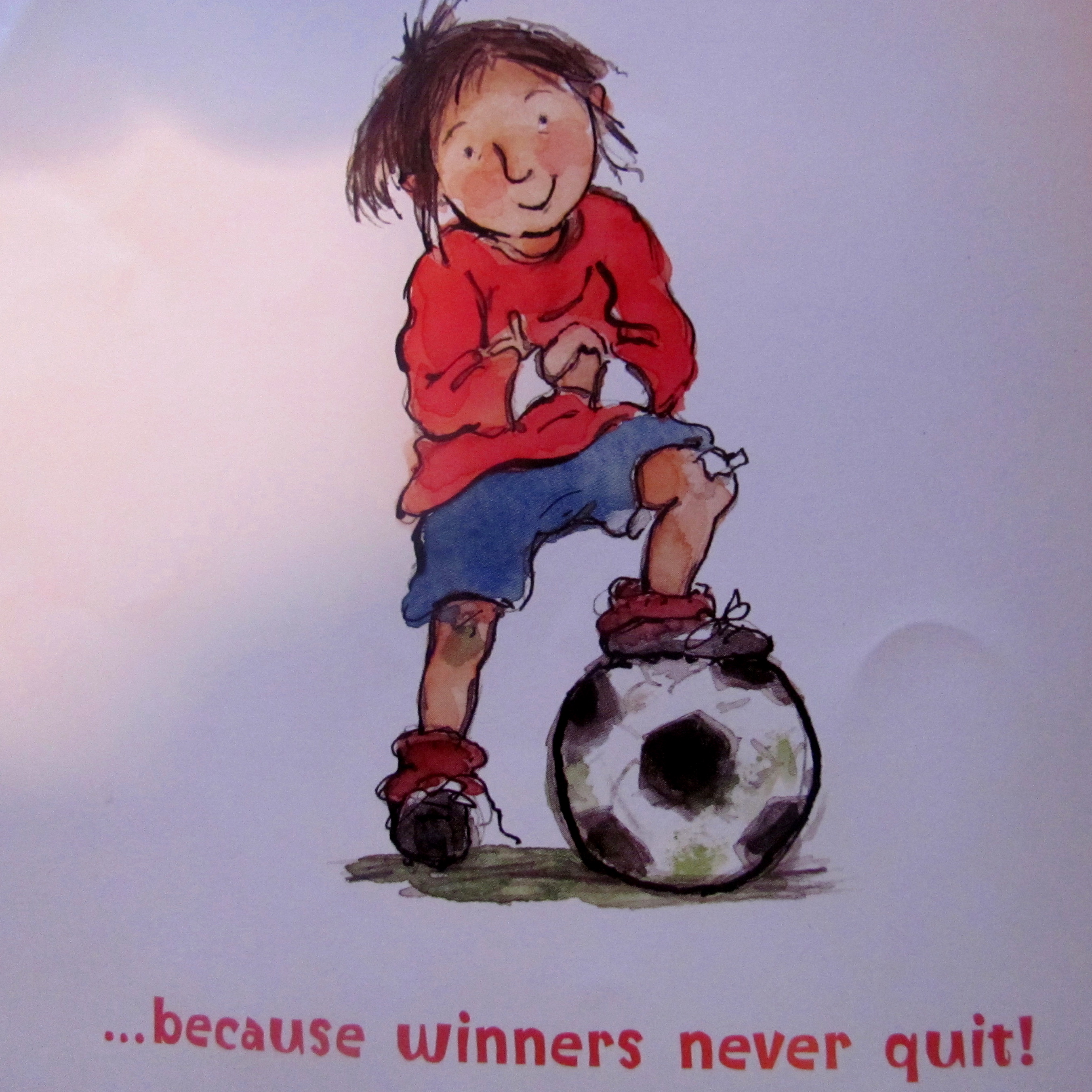
Obviously the message here is that its not whether you win or lose, its how you play the game. But its shown as a real life story, in a way kids can understand; Mia has intense emotions readers witness her learning how to deal with.

I feel like Mia wrote this book just for my daugter Lucy who is incredibly athletic at everything she tries– soccer, T-ball, basketball, air hockey (she didn’t inherit this from me.) At six years old, it is kind of rare to see a kid so aggressive, not wandering off the field or playing house in the goal. Lucy just keeps going after that ball. I obviously want to encourage her passion and skill. But she does cry when she doesn’t play well and says things like, “I’m terrible, I’m the worst.” And when she gets mad, she cheats.

I don’t understand her drive and skill because I wasn’t into sports as a kid. So I especially value this book, because it shows girls that competition is OK, which is something I wish I’d learned in sports and way beyond. I think it’s crucial to teach girls how to compete openly and ethically for victories that matter, so they don’t funnel those drives into backhanded ambitions too often focused on beauty, boys, and popularity, the venues through which girls have historically been allowed to win power.

Humans are competitive. Girls, too often aren’t taught how to deal with that, or even told that to engage in competition is bad. You’ve got to be especially wary where I live, in San Francisco, where many “progressive” schools believe every kid should be in the school play, on the team etc. I get this up to point, but learning to play fair, to want to win, that it feels good  when you do, are important lessons, key to helping girls grow into successful women.

At the end of the book, there are several photographs of Mia Hamm winning trophies, being carried by her teammates, and action shots of her playing soccer as a kid. I love all this imagery, illustrated and real, of a girl displaying her amazing skills and enjoying winning.

Thank you Mia Hamm!

Outside Over There ***GGG***

Sadly, just like two of my other favorite childrens’ book authors, Dr. Seus and William Steig, Maurice Sendak often leaves female characters completely out of his stories or gives them tiny parts.

Outside Over There is different–the three main characters are female. it’s a perfect story: strange, scary, and feminist. This book would make a great movie (are you listening Spike Jonze and Dave Eggers– or some female moviemakers out there?) It’s about  a brave girl who rescues her baby sister after she is stolen away by goblins.

The prose is classic Sendak– concise and beautiful. It begins, “When Papa was away at sea, and Mama in the arbor, Ida played her wonder horn, to rock the baby still, but never watched.” The accompanying illustrations are creepy and intense. The mother is shown in a daze, staring out to sea, obviously missing her husband horribly, not paying any attention to Ida who holds her crying baby sister. You can feel the aloneness and the abdonment the whole family is experiencing, but especially Ida, who is trying her best to take care of the baby, before she makes her fateful mistake of not watching.

Goblins sneak in the window and steal the baby, leaving one made of ice (an image that’s never completely left me) When Ida turns to hug the baby and feels her melt, she makes a fist: ” ‘They stole my sister away,’ she cried. ” ‘To be a nasty goblin’s bride.’ ” She climbs out her window into “outside over there” guided by the voice of her father from the sea. When she finds the goblins, she plays her horn until they dance into such a frenzy “they quick churned into a dancing stream.” Ida grabs up her sister, and brings her home to their mother, still in the arbor, now holding a letter from their father: “I’ll be home one day, and my brave, bright little Ida must watch the baby and her Mama for her Papa who loves her always. Which is just what Ida did.”

Like his much more famous book Where the Wild Things Are, this adventure story is told in less words than this review. Sendak is amazing. I wish more people knew about his best book.

If women ran the MPAA…

The following standards would urge caution for parents: any movie

1. where the leading woman is ten years younger (or more) than the leading man

2. where the mother’s real life age is the same as the guy playing her son

3. with a sidekick best friend who is super attractive but supposed to be unattractive because she’s wearing glasses

4. where the girl in glasses gets a makeover

5. where all the female roles are girlfriends or supporting

6. with cheerleaders

male frontal nudity is OK

female frontal nudity is OK only if it’s shown as a quick glimpse, coming out of the shower or in the locker room, not in a lingering sexual way (or the whole movie gets an NC-17 or X rating)

Amelia Bedelia


Every parent has a book that drives her crazy, that she hopes and prays her kid will not choose yet again, that she dreads reading. For me this book is Amelia Bedilia. Worse than Eloise, the fairies, even the ponies, AB is so annoying. That’s the point of all the stories, she misunderstands– whether its how to clean a house or play baseball.

Kids do think its funny when grown ups don’t get something obvious. The other day, my brother-in-law came out of the kitchen with a banana on his head, asking my three year old, “Have you seen a banana anywhere?” She was cracking up. The kid could not stop laughing. She thought it was the most hilarious thing she’d ever seen.

If Alice laughed like this when I was reading, I would forgive Amelia for being so irritating. But Alice sits there, totally straight faced– yet intrigued- while Amelia sprinkles face powder all over the sofa after she was told to dust it.

Amelia is so annoying, she doesn’t even fit in my rating system. She’s does nothing for girlpower, but she’s not really stereotyping either. Hate her.

The Three Little Wolves & the Big Bad Pig


This story gets a ***GG*** rating, and it has no major female characters. How is this possible?

Because it breaks stereotypes with a simple reversal. When I read stories, I often make gender switches in my head, to reveal the kinds of characteristics and plotlines we’ve heard so many times that we just take them for granted as something believable or successful. Anytime a story does the shake up for me, inspiring a jaded reader to think in a new way, I’m grateful. Next to the helpless, passive princess, wolves are probably the most maligned creature in fairy tale world. (About ten years a go, another writer made the same kind of connection when she compiled an anthology of myths about brave female protagonists called Women who Run with the Wolves.)

In the first scene of Three Little Wolves, we see these wolves as vulnerable, they are shown with their mother, described as cuddly, with soft fur and fluffy tails. Their mother urges them to go out in the world with the warning, “But beware of the big, bad pig.”

The story follows the classic model, describing the wolves’ adventures and challenges as they attempt to build safe homes for themselves, continually destroyed by the malicious, resourceful pig. I highly recommend this book. It’s so funny and poetic, reminiscent of Steig stories, and it has a beautiful ending.

Should kids’ books be rated?

The novelist and blogger, thinks they should.

I was thrilled to see this topic in the NY Times book blog. Though most comments to his post seem to disagree with him, thinking kids books should not be rated, that to do so is some horrible form of censorship.

I don’t see that at all. I see it as censoring the censors. Ha! Their ridiculous standards and values have ruled over our kids for far too long in an insane monopoly– I’m raging about the MPAA again. I know the MPAA doesn’t rate books, but they set a standard of what is “good” and what is “bad” that everyone seems to follow along with.

I’m not sure if Buchsbaum would agree or disagree with my major complaint that the typical censor/ rating types are not sensitive to or even aware of  or don’t believe things are damaging that I think are damaging and vice versa. His complaints seem to be with with adult themes and content finding their way into teen books.

Buchsbaum does rightly point out, anyway, that ratings are a guide, not censorship. Who has the time to read every kids book? See every movie? Examine every toy etc. I created this blog so parents could have some kind of resource to know about some alternatives out there to all the sterotypes the general media programs to our kids 24/7.

Phaedra ***SSS***

Phaedra is an adult play that I went to see last night with another adult, and this is supposed to be a blog about kids media, but I have to write about this play for the sake of womankind. But before I do, I want say– I had a great time going out–Moms, you’ve got to do it. Grown up time! Whoo-hoo! No cartoons! And spending time with my friend, having a glass of champagne at the Huntington Hotel was lovely. The play was well acted and engaging, but it got me so mad. I did try to imagine it in its time, before feminism blah blah blah.

It was a play about Greek mythology– what did I expect? Well, Greek mythology often illustrates the world in flux, before male domination completely took over, so often a powerful woman or two slips through in her full glory of female power as a goddess or a queen or heroine or something. Right before I went, I heard this play was about an older woman falling for a younger man, so I assumed, I wouldn’t be watching yet another Hollywood movie scenario of older man paired with nubile ingenue, that I was going to get a glimpse of female sexual empowerment.

But, no. The damn Greeks did not come through for me, and I was a philosophy major and should’ve known better. The play is by Racine, who I bet even by French/ Seventeenth century standards wasn’t the most progressive guy in town. It was obviously, also his interpretation of an ancient story, which, should we say, would differ from my own take on it if I were a famous playwright myself instead of blogging about famous playwrights.

Phaedra, the star of the play is totally humiliated and degraded for allowing lust to exist in her heart. It destroys her and her family and her lover. She is married to Theseus but falls in love/lust with his son, Hippoltytus. Another thing that annoyed me about the play, by the way, is the supposedly over the hill Theseus was way hotter, more charismatic, and a better actor than his stringy haired son, moping aound in his ill-fitting baggy leather pants. Nonetheless, Queen Phaedra confesses her love to this son, gets rejected by him (read major, pathetic humiliation here, moaning all around the stage, twisting her hair, punching her breast) and then Phaedra lets her husband beleive that Hippoltytus raped her (a popular, contemporary “myth” women have to deal with every day which is an issue I have with letting my complaints go b/c of the time). Theseus then curses his innocent son, who loved an innocent young woman, and the son soon dies. End of play– the theme being, repeated by most characters, that reason is good/ strong while love/lust is weak and bad.

I know the Greeks have done a lot of great things for civilization such as creation of goverment etc, but my (not orginal) beef with them is their central philosophical tenet of dualisms, popularized and further institutionalized, of course, by Descartes. Basically, the Greek philosophers believe: (1) the mind and body are separate (2) the mind/ reason is good, true, stable, immortal (3) the body is weak, defiled, emotional, untrustworthy, mortal (4) The way we understand and experience the world can be sorted into these dualisms. Guess which category those gender polar opposites, man and woman fall into? Answer of course: man– mind, reason, good; woman– emotion, body, bad

Here is what I think: the mind is part of the body (and located throughout the body– modern science now supports that if you care). Emotions are intelligent. The world does not separate into simple oppositions as former president, George Bush, would have liked, and maybe if we had not all been so influenced by the dualistic Greeks, we wouldn’t have so unanimously agreed to fight a complex war with a multitude of factions and tribes we can’t even understand. And, finally, just one more thing about the damn Greeks, their dualisms, and my re-occuring eating disorder theme– belief in these dualisms is why we are so messed up about food. Just listen to your body! It’s smart. Not some stupid calorie/ fat gram reasoned, researched, fact supported chart, which has no idea who you are or what you need. Let your body guide you and stop being at war with it. We are all going to die. Not sure how to deal with that, but that’s the real struggle underneath all of this, right? Did Rousseau– of noble savage fame– write any plays???

Planetarium***GGG***

Lucy and I finally braved the crowds, motivated by a week of being trapped inside by storms, to visit the planetarium at the Academy of Sciences in Golden Gate Park. Lucy is obsessed with Saturn and has been begging me to take her for months.

We saw a show called Journey to the Stars. Settling back in my seat, listening to the narration, there was something distracting about the voice. And then I realized– it was a female voice.  I am so used to watching these epic nature films accompanied  by a booming, authouritarian, voice of God type (what we call in talk radio, where I used to work– a three ball voice. Gene Burns, if you know who he is, has one. Casey Kasem too, James Earl Jones, of course.)

“Journey to the Stars” is narrated by Whoopi Goldberg. It’s wonderful. My only complaint is the planetarium is not a planetarium, its not a dome, it’s a half dome, more like an Imax theatre, in fact, just like an Imax. What’s up with that?***GGG***

Ladybug Girl

At first glance, Ladybug Girl doesn’t appear to be the most original of heroines. She’s pictured on the book’s cover in the same frilly-stiff red tutu that two of my daughters wore last halloween, cloned by half the girls in San Francisco; the other half dressed up as butterflies or fairies, only differenciated by tutu/ wing coloring. (Though now, I hope my third daughter shows the same obsession because the costumes cost me $60 each.)

But there is something special about this Ladybug girl. First, full disclosure, my standard bias: as I mentioned in my Princess Hyacinth review–  as a brown-eyed, brown haired kid, reading obsessed and deluged with golden haired blue eyed beauties, I give extra originality points for the, still rare, kids’ heroines with alternative coloring.

But there’s something truly wonderful about this story, and something that I never thought of before. This book shows that a girl’s obsession with ladybugs (and by proxy, butterlies) though packaged in the mainstream world as a gender stereotyped attraction to patterns and colors–is, at its heart, a love for bugs, for the outdoors and the creatures of the earth.

Ladybug Girl wanders around her backyard (another great thing about this book is it shows how our overscheduled kids handle free time; one of my favorite scenes shows Ladybug Girl, before making her decision to go outdoors, in her room overflowing with toys, frowning, arms crossed, saying, “There’s nothing to do.”) When Ladybug Girl is playing outside with her dog, she gets muddy and wet, splashing in shark-infested puddles, spying on other creatures including her big brother, buiding stone forts, and rescuing bugs.

Reading Ladybug Girl reminded me of my daughters, and the many ways they have shown me their fascination with bugs and insects (and tiny frogs–ugh) and how it’s not an interest I’ve ever encouraged or reinforced with toys, games or my own excitement– except by buying them silly frilly costumes.

I’ve often discovered Lucy and Alice quietly spying on long-legged spiders they find in the bath or mesmerized by fuzzy, slow-moving bumble bees flying low in our backyard. And their favorite thing to do, every time we leave the neighborhood park, is to visit the “ant tree,” where a trail of ants march up and down the trunk. The girls each let an ant crawl onto their finger, and then they literally love that ant to death. Then they cry and ask me to bring it back to life.

I’ve never once bought the girls the ant homes marketed to little boys, or insect puzzles, or rented A Bug’s Life, or asked them if they wanted to go dig for potato bugs when we had nothing to do–even after Lucy brought one home from school in a tiny cardboard box complete with a bed and play area.

Reading this story about a bored girl freely playing outside and getting dirty made me think of how many times I’ve warned my daughters not to get messy, as if it were the most horrible thing in world. I’m thinking, of course, that I’ll have to wash their clothing or they’ll track mud through the house. But Ladybug Girl taught me to mellow out and not get so worked up. (I’m not even a neat freak– far from it, and it was still hard for me to let it go) We have a backyard, always in flux, always muddy; there’s a hill they call a mountain they love to climb and dig around in. Now I just let them, stopped worrying so much about them fallling (into what?  more mud) Now they climb and explore far more bravely, both at home and in parks. They ask me to take them on hikes.

I also hope that letting then get messy when they play outside, and really acting like it’s no big deal takes back some emphasis from the frequent visual reaction they get: “What a beautiful dress you are wearing!”  They love to get special attention for anything, of course, but hopefully exploring and getting dirty can be more fun than even that.

A final cool thing about the book– and I think this is the author’s winking about the generic costume featured on the cover: the illustrations on both the front and back inside covers show Ladybug Girl is in a variety of costumes including a pirate, ballerina, witch, movie star, artist, astronaut, unicorn, pilot etc; the point being, of course, girls can be anything. I’d love to get a blow this up and frame it.  ***GG***

(P.S. The extra ladybugs in the photo are pistcachio half-shells Lucy painted for a math counting school project)

Charlie and Lola

Charlie and Lola

Lola is smart, mischevious, and my kids totally relate to her big issues of refusing to go to bed, go to school, or eat a tomato. The series theme (and book titles) often feature Lola’s passionate complaints about the her life, similar to the Junie B. Jones series, but somehow, instead of coming off as a horrible, intolerable brat as Junie B. does, Lola is appealing. The reason is because readers experience Lola through the eyes of her older brother, Charlie, who loves and admires his troubling sibling.

Each book begins: “I have this little sister, Lola. She is small and very funny.” Though this brother-sister dynamic is sterotypical of kids books– elder brother guides his younger sister, his name always comes first (see my Magic Tree House post) Charlie is an especially kind and perceptive caretaker. He’s such a great older brother that, for the longest time, I assumed he was a girl. I didn’t even wonder. Which is remarkable for me because I’m supposed to be so hyper-sensitive to this stuff.

Charlie looks just like Lola– same shaggy hair, tiny nose (looks like three tiny fingers pointed downwards) and dark, almond eyes. It was my husband who broke the news. After a brief debate and looking carefully at the pictures, I had to concede– Charlie is, in fact, a boy. His jaw is slightly broader than Lola’s, he’s always in pants (Lola’s shown in a dress), he has a best friend named Marv; they play soccer together and walk Marv’s dog. Charlie does nothing in these books explicitly girlie.

Though my husband was right, I have to assume the author, Lauren Child, intended some gender ambiguity with the name choice and giving the two kids such a similar look. Charlie is always pictured in a shirt that reads “Charlie,” I think so kids can tell them apart. If any of you had similar questions about Charlie, let me know.

The collage type illustrations are beautiful and compelling. (Lauren Child also ilustrated a book we have of Pippi Longstocking and wrote and illustarted a version of The Princess and the Pea.) The text in all Child’s books is always visually interesting, in different sizes, bold face and italics, words swirling into loop de loops.

I liked this series so much that I kept buying new books but became disappointed. I think  Child must have sold the series. Later books are more like slogans (recycle!) than stories, include pages of stickers, and large seals on the cover urging readers to watch Charlie and Lola on TV. ***GG***