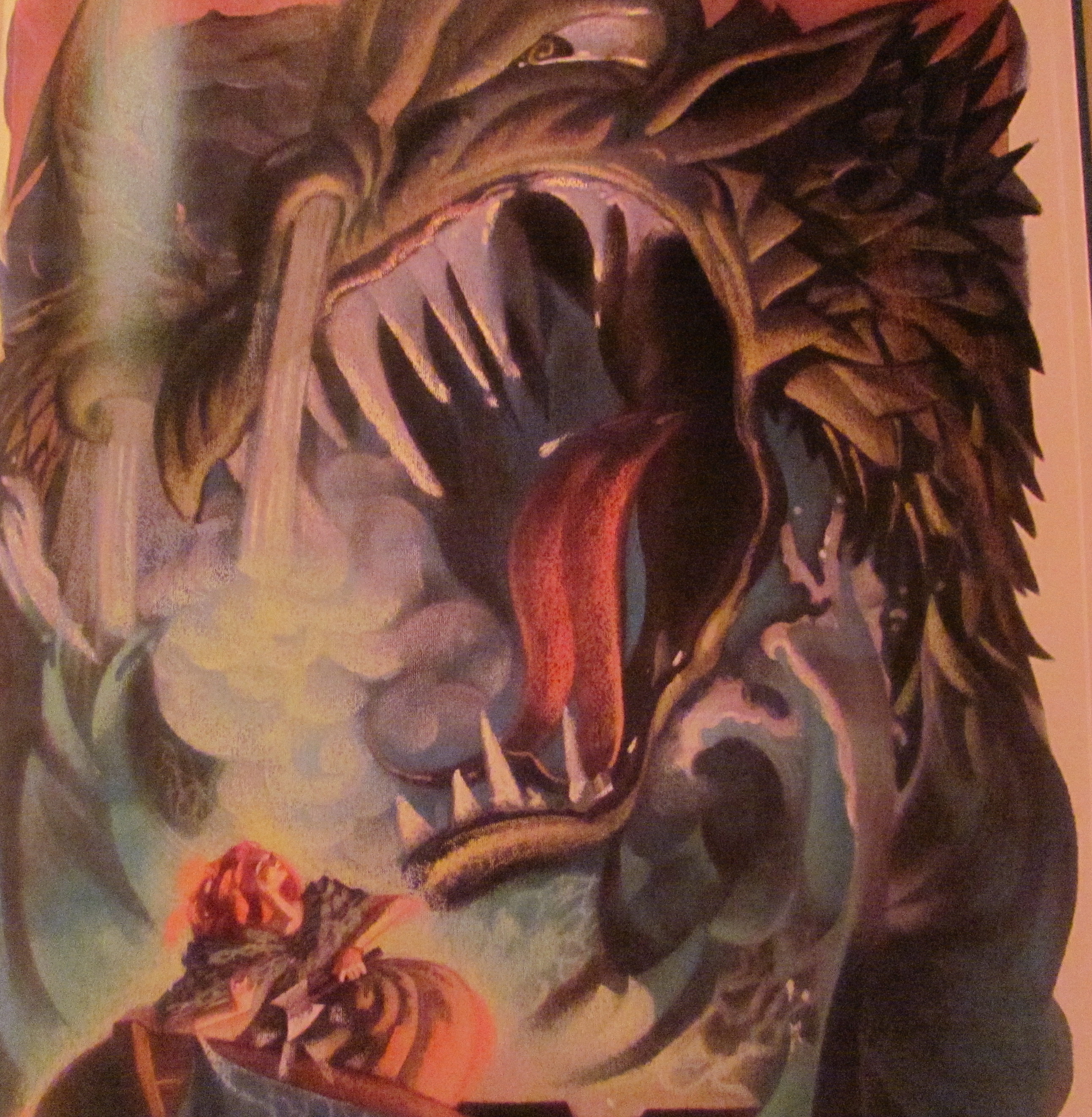
Sadly, just like two of my other favorite childrens’ book authors, Dr. Seus and William Steig, Maurice Sendak often leaves female characters completely out of his stories or gives them tiny parts.
Outside Over There is different–the three main characters are female. it’s a perfect story: strange, scary, and feminist. This book would make a great movie (are you listening Spike Jonze and Dave Eggers– or some female moviemakers out there?) It’s about a brave girl who rescues her baby sister after she is stolen away by goblins.
The prose is classic Sendak– concise and beautiful. It begins, “When Papa was away at sea, and Mama in the arbor, Ida played her wonder horn, to rock the baby still, but never watched.” The accompanying illustrations are creepy and intense. The mother is shown in a daze, staring out to sea, obviously missing her husband horribly, not paying any attention to Ida who holds her crying baby sister. You can feel the aloneness and the abdonment the whole family is experiencing, but especially Ida, who is trying her best to take care of the baby, before she makes her fateful mistake of not watching.
Goblins sneak in the window and steal the baby, leaving one made of ice (an image that’s never completely left me) When Ida turns to hug the baby and feels her melt, she makes a fist: ” ‘They stole my sister away,’ she cried. ” ‘To be a nasty goblin’s bride.’ ” She climbs out her window into “outside over there” guided by the voice of her father from the sea. When she finds the goblins, she plays her horn until they dance into such a frenzy “they quick churned into a dancing stream.” Ida grabs up her sister, and brings her home to their mother, still in the arbor, now holding a letter from their father: “I’ll be home one day, and my brave, bright little Ida must watch the baby and her Mama for her Papa who loves her always. Which is just what Ida did.”
Like his much more famous book Where the Wild Things Are, this adventure story is told in less words than this review. Sendak is amazing. I wish more people knew about his best book.
At first glance, Ladybug Girl doesn’t appear to be the most original of heroines. She’s pictured on the book’s cover in the same frilly-stiff red tutu that two of my daughters wore last halloween, cloned by half the girls in San Francisco; the other half dressed up as butterflies or fairies, only differenciated by tutu/ wing coloring. (Though now, I hope my third daughter shows the same obsession because the costumes cost me $60 each.)
But there is something special about this Ladybug girl. First, full disclosure, my standard bias: as I mentioned in my Princess Hyacinth review– as a brown-eyed, brown haired kid, reading obsessed and deluged with golden haired blue eyed beauties, I give extra originality points for the, still rare, kids’ heroines with alternative coloring.
But there’s something truly wonderful about this story, and something that I never thought of before. This book shows that a girl’s obsession with ladybugs (and by proxy, butterlies) though packaged in the mainstream world as a gender stereotyped attraction to patterns and colors–is, at its heart, a love for bugs, for the outdoors and the creatures of the earth.
Ladybug Girl wanders around her backyard (another great thing about this book is it shows how our overscheduled kids handle free time; one of my favorite scenes shows Ladybug Girl, before making her decision to go outdoors, in her room overflowing with toys, frowning, arms crossed, saying, “There’s nothing to do.”) When Ladybug Girl is playing outside with her dog, she gets muddy and wet, splashing in shark-infested puddles, spying on other creatures including her big brother, buiding stone forts, and rescuing bugs.
Reading Ladybug Girl reminded me of my daughters, and the many ways they have shown me their fascination with bugs and insects (and tiny frogs–ugh) and how it’s not an interest I’ve ever encouraged or reinforced with toys, games or my own excitement– except by buying them silly frilly costumes.
I’ve often discovered Lucy and Alice quietly spying on long-legged spiders they find in the bath or mesmerized by fuzzy, slow-moving bumble bees flying low in our backyard. And their favorite thing to do, every time we leave the neighborhood park, is to visit the “ant tree,” where a trail of ants march up and down the trunk. The girls each let an ant crawl onto their finger, and then they literally love that ant to death. Then they cry and ask me to bring it back to life.
I’ve never once bought the girls the ant homes marketed to little boys, or insect puzzles, or rented A Bug’s Life, or asked them if they wanted to go dig for potato bugs when we had nothing to do–even after Lucy brought one home from school in a tiny cardboard box complete with a bed and play area.
Reading this story about a bored girl freely playing outside and getting dirty made me think of how many times I’ve warned my daughters not to get messy, as if it were the most horrible thing in world. I’m thinking, of course, that I’ll have to wash their clothing or they’ll track mud through the house. But Ladybug Girl taught me to mellow out and not get so worked up. (I’m not even a neat freak– far from it, and it was still hard for me to let it go) We have a backyard, always in flux, always muddy; there’s a hill they call a mountain they love to climb and dig around in. Now I just let them, stopped worrying so much about them fallling (into what? more mud) Now they climb and explore far more bravely, both at home and in parks. They ask me to take them on hikes.
I also hope that letting then get messy when they play outside, and really acting like it’s no big deal takes back some emphasis from the frequent visual reaction they get: “What a beautiful dress you are wearing!” They love to get special attention for anything, of course, but hopefully exploring and getting dirty can be more fun than even that.
A final cool thing about the book– and I think this is the author’s winking about the generic costume featured on the cover: the illustrations on both the front and back inside covers show Ladybug Girl is in a variety of costumes including a pirate, ballerina, witch, movie star, artist, astronaut, unicorn, pilot etc; the point being, of course, girls can be anything. I’d love to get a blow this up and frame it. ***GG***
(P.S. The extra ladybugs in the photo are pistcachio half-shells Lucy painted for a math counting school project)
Brave Margaret is one of the best kids books I’ve come across. It’s a Celtic fairy tale, a true adventure story– exciting and beautifully illustrated. Margaret faces stormy seas, a terrifying serpent, and a self-serving sorceress. The story is completely centered on Margaret’s journey, though it does end in a happily ever after scene with a prince. Still, Simon is a hottie (I have a soft spot for Irish men) who obviously loves and admires Margaret for her bravery and her brains which makes the story romantic enough so the ending fits. Also– I love Margaret’s look. Yes, she has long flowing hair but it’s all kinds of shades of fiery red. One of my pet peeves with children’s books is that even when there is a girl in constant action, the pictures are of the moments she happens to be stationary: smiling, hugging, sitting, whispering, or brushing her hair (this is true even if the girl characters happen to be ponies, cats, fairies, bugs etc). Not so with Brave Margaret– most illustrations are action shots: Margaret galloping on her black horse, brandishing a sword; rowing a boat on her own in the stormy sea; swinging an ax by a serpent’s mouth. My friend who recommended this book bought it at a garage sale for $1. It’s copyright is 1999. I hope it’s still available, I want to get my own copy. Please give suggestions for girl power kids books you love. They don’t have to be new.
This post is really about kids and food. I realize even girls and food is a digression from my main blog mission which is supposed to be to rate and recommend media and products on how empowering they are to girls. But as I write and think about media and girls, the way I think about food and girls is so related. Besides, the whole point of a blog is you get to digress, right? So here I go.
I mentioned a few posts back I don’t want to forbid toys like Barbie because I think that gives her a charge that only makes kids want her more; I think candy, junk food, is the same way. I try to get really excited about things I think are good for my kids and give little attention to things that are not so good.
A main goal for me as the mother of three girls is to help them grow up without eating disorders. I know its pretty sad that this is something I have to think about but I see so few women eat normally and joyfully.
So after I gave birth to daughter #2– who wants to be called Magnolia in this blog — I read an incredible book called Preventing Childhood Eating Problems. It is by Jane Hirshmann and someone else who I will look up. Anyway, GREAT book. I follow it to the letter and my kids are amazing eaters. They are not picky, they are open to trying new foods, they eat a huge variety of foods and we rarely fight about food. (God, I hope I am not taking all this back when they are teenagers.) But the whole idea is you let your kids eat whatever they want. You let them eat when they are hungry until they are full. It makes sense, I mean let the poor guys control one thing in their lives. Why shouldn’t they eat when they are hungry? Magnolia and Arania (my 6 1/2 year old’s chosen moniker– OK, maybe they’re way into the princess thing after all) each has a food shelf in the cupboard and in the refrigerator. They pick out the food for their foodshelf and they are allowed to go to it and eat whenever they want, even during dinner if they don’t like dinner. We cook one hot meal for dinner; we are not short order cooks. But if they don’t like it, they don’t have to eat it, and we don’t take it personally. Think about it– say you love steak and your husband makes you an amazing steak dinner with a baked potato but you really feel like a salad that night. Maybe you eat the steak anyway so he won’t feel bad. Wrong reason. But can you imagine him forcing you to eat it because that’s your dinner and it’s good for you? This is all from the book, not me.
The kids food shelves have granola bars, tangerines, carrots, M n Ms, cashews, rice cakes, raisins, cheese, lollipops, yogurt etc. They have another cereal shelf that has sugary cereal and cheerios etc they can access. They have an abundance of food, more than they could eat. I don’t give them trouble about wasting food. I feel like they have enough to worry about just learning how to eat right now.
The idea is that there is no “good” food or “bad” food. Forbidding certain foods, calling certain foods dessert that kids are only allowed to eat when they finish other food, using food as a reward or a way to feel better after a cut or a scrape gives food all kinds of power. This book basically teaches kids to tune into their own hunger and meet it. Sadly, I did not learn to this until I was twenty-eight years old, after years of therapy and programs. Nothing ever really helped me get better from an eating disorder until I went to this place in Marin Country called Beyond Hunger which teaches the same practice: eat when you’re hungry, eat whatever you want, stop when you are full. I think the most amazing thing about it is that your orientation switches from outward (calorie counting, nutritionists, the latest diet fad) to inward (“what do I want?”) It’s a skill but I am enormously grateful I learned it and hope to keep passing it on to my daughters.
We do have dinner time but we call it “family time.” We hope that they eat and it is their last chance to eat before bed. They were trying to use this system to manipulate bedtime, if we let them have snacks etc. If they don’t like what’s for dinner, they can go to their foodshelves, but usually they don’t.
In the morning I do say things like “Yum! Cheerios! That’s what I’m going to have.” We call peas “pea treats” and say things like “Who gets the peas first?” We say yum a lot around vegetables or we love the way carrots crunch etc. My kids– like most kids I think– are really influenced by my own food choices and watching me eat. I am really glad I got myself healthy years before I had them.
One challenge I have had with this system is that other kids (Magnolia and Arania’s friends) do have lots of rules around food so there have ben arguments with other kids and their parents at my house. The way I deal with this– the book has good advice– is one rule I have is that my kids cannot feed anyone else or tease people with or about food or it gets taken away.
Read my responses to all the comments & questions I got about this post here.
Awesome. I adore this guy. He’s the best– both in animation and girl power. I know he’s a guy, so that’s the only drawback I guess, but that can be a plus too, that he has that kind of insight. Spirited Away, his classic, is my favorite. It’s just beautiful to watch. And Sen, the main character, is brave and cool and also emotional and real. Her parents turning into pigs did freak my kids out, it freaked me out; that scene is intense. I also love Kiki’s Delivery Service. recently, I saw Ponyo in the movie theatre whichw as such a great, powerful take on the lamest of movies– The Little Mermaid. My only issue with MIyazaki is you have to be in the mood, it s a commitment to watch one of these epic films and sometimes my mind drifts. And I suppose, with Ponyo, it really was much more about the animation that the story, there wasn’t much tension or conflict. The boy– I forget his name right now– is in love with Ponyo the fish, and his love is tested but you never doubt that this earnest, sweet boy’s love is true. Miyazaki gets my highest rating GGG.

 Sadly, just like two of my other favorite childrens’ book authors, Dr. Seus and William Steig, Maurice Sendak often leaves female characters completely out of his stories or gives them tiny parts.