
Steven Spielberg’s “Adventures of Tintin” may have the best animation style I’ve ever seen in a kids’ film. It’s almost as if you can’t tell if the characters are real people or art. It’s spectacular.
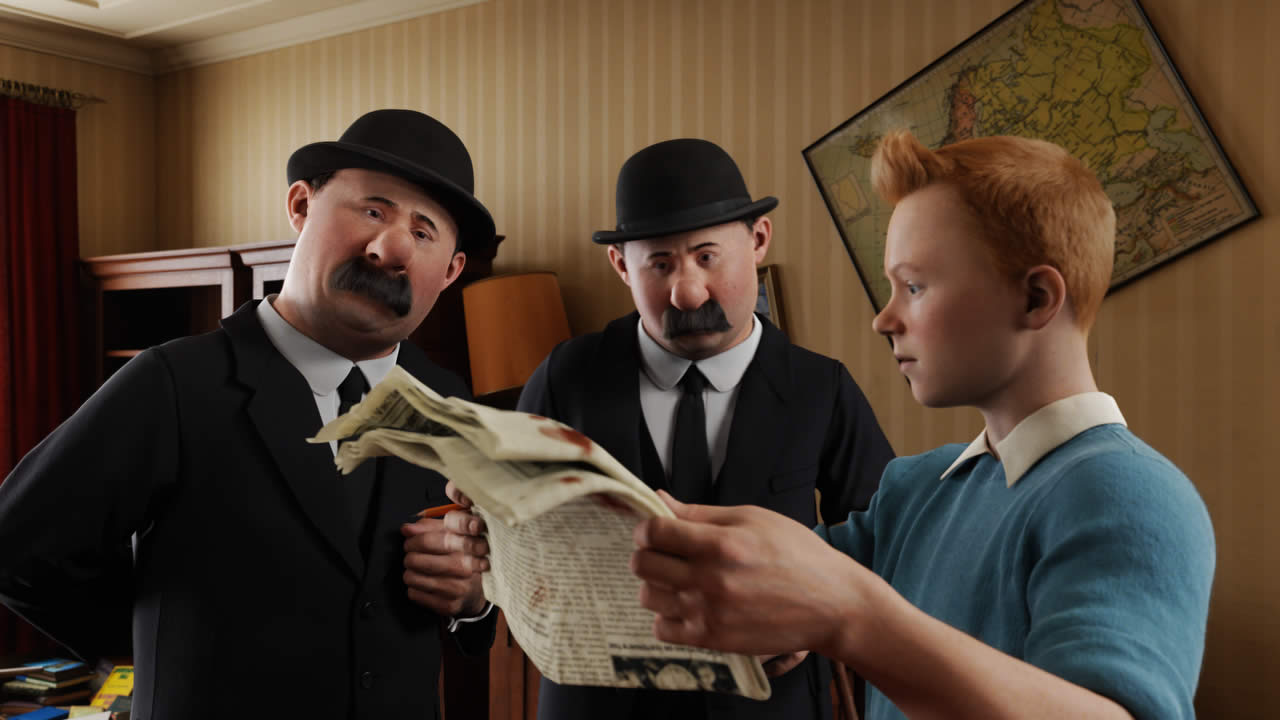
But I guess Spielberg was so focused on the animation, he forgot about half of the kid population. There are so many males and so few females in this movie that I– even me– was blown away. If a Martian came to Earth and saw this film, she would think our species was the type that clones itself to reproduce. The movie even has two twin mustachioed investigators that would seem to support that hypothesis.
Like most kids movies, this is a buddy movie (can I say “friendship” movie?) The three buddies, the main characters in the film– Tintin, Captain Haddock, and Snowy the dog– are male.

All the villains are also male, the gangs of them. The good guys are male as well, almost to caricature as mentioned with the clone investigators.
For female roles, there is a housekeeper, an old lady that hits someone with her bag, and a third who my daughter spotted when I went to the women’s room. My daughter said she was a singer.
I know, I know: Tintin was a book before it was a movie. What’s Spielberg supposed to do about that? He’s just one director trying to be faithful to his inspiration.
Tintin was actually many books, and “Adventures” ended with a teaser that practically announced the next film.
And guess what, there’s a video game too.

Do you think there will be a Lego set?
Reel Girl gives “The Adventures of Tintin” an SS rating. In spite of its almost total lack of females, Tintin escapes the dreaded Triple S. The females in the movie don’t do anything terribly, stereotypically offensive such as talk about their hair or their boyfriends, though they don’t interact with each other at all and one is a housekeeper.
Update:
After I posted about the lack of females in the new Tintin movie, a commenter wrote in this quote from Herge: “For me, women have nothing to do in a world like Tintin’s, which is the realm of male friendship.”
I googled the quote and all kinds of references came up, this one from Wikipedia:
Hergé has also been accused of sexism, due to the almost complete lack of female characters in his books. The only woman character of importance is Bianca Castafiore, who is potrayed to be foolish and nearly oblivious to all negative reactions to her behaviour — though she does show loyalty, presence of mind and quick wit when hiding Tintin and Haddock from Colonel Sponsz in The Calculus Affair.
Hergé himself denied being a misogynist, saying that “for me, women have nothing to do in a world like Tintin’s, which is the realm of male friendship”.[10]
Other reasons were because he believed that sentimentality had little to do in Tintin’s stories, which are mainly about men getting into all sorts of “misadventures rather than adventures”, and wherein “mocking women would not be nice”. He also felt that a man slipping on a banana skin, providing he does not break a leg, is much funnier than if it happened to a woman. As a female interviewer put it, “It has nothing to do with the misogynist world of the boy scout,”[11] referring to the fact that Hergé was a scout in his youth.
OK, Herge denied being a misogynist and then says “women have no place in a world like Tintin’s.” Um, that is misogyny.
Wikipedia tells us: “Tintin’s stories, which are mainly about men getting into all sorts of ‘misadventures rather than adventures’, and wherein ‘mocking women would not be nice.’ ”
Maybe that isn’t the full quote. Maybe it’s not in right context, but as it stands, Herge implies that the only reason to include women would be to mock them? Is there no other reason to include female characters in a story?
“Other reasons were because he believed that sentimentality had little to do in Tintin’s stories…”
So including women requires sentimentality?
And slipping on a banana peel is funny if you’re a man but not a woman? What?
I don’t get it. All the ways the Wikipedia writers and Herge attempt to explain away his sexism are sexist. What do they think sexism is? Maybe they excuse Herge for similar reasons that Reel Girl rated “Tintin” with two SSs for gender stereotyping instead of three; there weren’t blatant offensive acts in the movie, so the movie didn’t get the worst rating. Females aren’t “mocked” because of their gender, they’re just not there.
The sick thing is that when you see “Tintin,” when it comes to women, you can tell there’s something off in the mind of the creator. The lack of females is glaring and weird and disturbing. And this is a movie for kids! Doesn’t Stephen Spielberg care? Don’t parents? When Spielberg shopped this film around to studios (maybe Spielberg doesn’t do that) did anyone say, “Interesting story, but there are no females in the entire series. That might be a problem for us. Half of kids, after all, are girls.”
I guess no one said that. Sadly, Tintin” is actually not disturbing to audiences, because most of the movies made for kids today have casts pretty much identical to this one, a series created by an artist who believes women have no place in his imaginary world.
Update:
I got this comment on my Tintin post from Neal:
Funny, my wife, daughters, son and parents didn’t notice this absence. They saw a film they enjoyed. As a reader of the original series I can tell that you’ll be disheartened to learn that this absence continues. Stop badgering Spielberg about this. You should be congratulating Kathleen Kennedy who is one of the producers and a long time collaborator of Spielbergs.
If Neal went to a film where the three main characters were female, all the heroes and all the villains were also female, do you think he might notice?
Sexism is so ingrained, people use it to defend sexism. Wow.
Update:
Commenters are defending the Tintin movie, writing that creator Herge’s sexism was simply a product of his times.
Margot, you are aware that Hergé wrote most of his comic books (including the three on which the film is based) before WWII, at a time when women in his home country of Belgium as in many others didn’t even have the right to vote? Of course his work reflects the prejudices of that era, not only towards women but towards just about everyone who wasn’t a white Christian male (the most egregious example being Tintin in the Congo)!

Would Steven Spielberg adapt Herge’s racist views (“of his times”) expressed in Tintin in the Congoto make a movie in 2012 and market that movie to kids?
Of course not. No one would see it. People would be horrified. Herge’s racist views are universally recognized as the aberration that they are. Why is Herge’s “dated” sexism celebrated in a loyal adaptation from one of our most acclaimed directors?
There are two answers, both are true. The first one is that in 2012 sexism is, in many ways, just as accepted and “normal” as it was in 1932. Women are humiliated and degraded all the time, but while racism is seen as a political issue, sexism is still seen as a “cultural” one.
The second, less controversial explanation is that in Herge’s comics, he directly degrades and humiliates Africans whereas his sexism mostly manifests as an omission. His racism is worse. Herge believes women have no place in his imaginary world. Is that offensive? Is it even sexist?
It’s an annihilation.
What is remarkable about this annihilation, and what I was writing about, is that it’s consistent with the casts of most animated movies made today. A story originally created by an artist who spoke openly of how he didn’t think females should be included in his imaginary world is almost indistinguishable from the majority of films made for kids right now. Steven Spielberg probably didn’t even notice.
What does that say about how important we think girls are?
See Reel Girl’s Gallery of Girls Gone Missing from Kids Films in 2011.
I didn’t notice it when I was younger but I do find it unfortunate that there were no major female characters in Tintin. The stories are still great however and they don’t express any misogyny towards women. It should be noted that in the comic Tintin is asexual and has no family to speak of. In the beginning it’s just him and his dog.
Also, you failed to understand what Herge said. He said he likes to mock the characters he draws to elicit humour and he doesn’t find mocking women funny. He didn’t say the only reason he would include women was to mock them but rather the only reason he draws characters is to mock them.
The other main characters that have been introduced who have been male are not treated seriously and only serve to provide comic relief and ocasional plot development. Captain Haddock is a clumsy oaf who is subject to a lot of pratfalls, Thompson and Thomson are oblivious oafs who are incapable of doing anything right and Professor Calculus is hard of hearing and misinterprets everything said to him.
Eventually Herge did add a female character in this vein with Bianca Castafiore who is an opera singer who irritates Haddock with her singing and affection. She is in fact less flawed than the male main characters only having excessive pride as a fault.
I think this is absolutely true.
I think Herge could’ve been an Asexual too and in those times I don’t know what was the opinion of society on friendships between men and women, but I suppose he didn’t have many female friends.
That could be the reason why he didn’t include them that much, he simply wasn’t thinking of them very often, so it felt natural for him not to draw them that much.
I’ve been there myself, I’m an Asexual and I’ve been drawing and creating stories since i was like 9 years old. Only this year, I’ve finallly started including more male main characters (I’m 17 now). It just felt natural to me to draw only girls, because I was never really that interested in boys, all my friends were girls and I, as a girl, could obviously relate better to a girl protagonist.
Don’t get me wrong, I always wanted a really good guy friend, but i guess I always scared them away (I was a little fighter girl in the elementary school)
Thank you for acknowledging the possibility of Asexuality…
Good article. Hergé definitely falls into that category of great artists and writers whom had their flaws, see Dickens, Dahl etc. The question is whether they could have come up with the same pieces of art, had they not had those flaws, i.e. comes with the territory.
For the record, I read that Dickens got called out for his anti-Semitic portrayals, and hence-after toned them down. Also, there was no reason why Spielberg couldn’t have added more females to the film: Again with Dickens and contemporary adaptions of Oliver Twist, Fagin is portrayed in a much more sympathetic light than in the original script.
This article really bothers me, if there was a female main character then there would be manipulation. No matter how distorted and demented today’s “feminist” view on the world is, females are naturally more emotional and manipulative than males. There shouldn’t be any of that in a story about male friendship. It’s that simple…I don’t know who hurt you in the past or if you have nothing to do; but this stuff is really unproductive and the only audience that would find this article appealing would be either white knights who are desperate and fantasize about the pussy they never get or teenage girls who are too ugly to get hit on by guys.
But thanks for sharing.
What a stupid article! Have you even read Tintin’s comic books? (By the way, the movie sucks! It is NOTHING like the books).
Anyway, there are no women in Tintin in major roles (except for Bianca Castafiore*) because women are always complaining and nagging, thus interrupting the adventure, or if not they would require sex, which would not be apt for children. The focus is in the adventure and in the male friendship. Don’t like it? Go watch My Little Pony.
* Bianca Castafiore is a major character in Tintin, specially in the later books, and you can say that there is a kind of love interest for Captain Haddock, so there’s that. Also, General Alcazar’s wife plays an important role in the last book, The Picaros. But yes, no young women – they are too distracting, with their boobs and stuff.
The media is so full of bad teaching and bad stereotypes, that I wont let me kids grow up with the TV. The TV is woman unfriendly, teaches kids that their parents are dumb, their dad is nice but a wimp, their mom is bitchy, that they can best keep secrets from their parents, that guys solve things best with violence, that women who are fat are bad people, that only men can lead, that black people are stupid and not beautiful etc etc.
Keeping the media out of the door is not a bad thing. They will still see it outside home, but it will be a much smaller part of their life.
I agree that the media is full of bad stereotypes, I can honestly say that I have never seen a movie that show gender equality the entire film. Though I’ve heard that “Tomorrowland” is a step in the right direction.
That might explain why Tomorrowland was a commercial and financial disaster. No Schadenfreude from me. I’m a woman.
Let me point out that in the original French version of the books, Snowy is named Milou, an androgynous name. It would seem as if the gender of Snowy was left to be ambiguous, until I realized that the name Milou was derived from Hergé’s first girlfriend. It is for this reason that I believe Snowy, arguably the character with the most screen time, is female. Just my POV on things 🙂
Even though I wish one of though I wish one of the main characters in Tintin was female in the original French version of the books and tv series Tintin repeatedly calls milou a boy by calling him in the masculin term for example “mon vieux” an French way of addressing a friend instead of the femine term “ma vielle” being a female I have never thought odd that the characters in Tintin were male however it makes me realize the sad truth that if the series would have been made with only female characters in it or if tintin would have been a girl that it would have probably not have had the same success then him being a boy. I have always wondered and still wonder why it is that when a book or movie has only or a lot of male characters its considered normal or good but if a movie ha mostly girl characters it is considered a girl movie or uninteresting? It makes me sad to think that just because I am a girl even if I accomplish the same things as a male I will never have the same recondition as I would if I were a male
Hi –
I’ve noticed that many – not all – but many Spielberg films have a striking imbalance between male and female characters or portray women as cartoonish. I think this is in part because of the material he’s drawn to – e.g., WWII and Saving Private Ryan and I guess this Rin Tin Tin movie, which I haven’t seen. The movie of his that really jumped out at me and made me wonder about how he views women is Catch Me If You Can. The men in that movie were all flawed but ultimately likeable. The women in that movie – and there were a lot of them – were all awful. The women were either cold, manipulative, horrible people or complete idiots (remember the stewardesses guessing that planes flew at 50mph or something ridiculous like that). That movie got me to wondering about Speilberg because I was so offended by the movie. I don’t know if he is a misogynist, but I do think it’s safe to say that looking at his body of work that with the exception of The Color Purple, there are few compelling, memorable female characters in the large body of movies he has directed. Just scan the list of movies – it’s striking.
Hi Sarah,
Totally agree. Also, I read many times that he didn’t want his wife, actress Kate Capshaw, to have a career and she complied.
MM
You have evidently never read the Tintin books, or if you have you are a little dense and have misunderstood the premise. If you were to do so you would (probably) enjoy them – they have truly excellent plots and illustrations. This article does not take into account the fact that they are written primarily for the amusement of 5-14 year old males, and being of a different era it would have been unusual to say the least had there been loads of female characters. This article was petty and ill informed and not particularly well written.
Hello,
I found this site while looking for pictures of female characters in Tintin to send to a friend and stopped right there, a bit intrigued. I found your accusations very disturbing since they are absolutely false, on every single point (argumentation is weak based on lack of evidence, smoky understanding of basic concepts and lack of proper rethoric) your blog might attract people and comfort them in their prejudices. The ones I hear once in a while on Hergé’s Tintin, but also on the cosmic range of targets very often attacked by a small and vocal branch of the “feministic” movement. This perticular group applies labels of sexism or misoginiy in a hazardouss way, in a fashion I find dishonest. It looks as though, sometimes, they’re looking deliberately for opposition between sexes even when that’s not needed. Feminism, by definition should not be about definitive equality, but about inclusion of each sexes richness and acceptation of their fundamental differences.
Tintin is a cartoon that started in a newspaper for boyscouts called Le Petit Vingtième. Hergé was a scout himself. Considering that this organisation is modeled after the army, it is safe to say that the first cartoons of Tintin did not reach the eyes of many little girls. The story tells the adventures of this fictitious reporter for Le Petit Vingtième in foreing countries. The world is seen through his eyes and is supposed to inform the readers about the culture of these countries and to entertain. In its true boyscout spirit Tintin preaches the values of fellowmanship and hardiness, Snowy the ones of cleaverness and faithfulness. Tintin, is believed to be somewhere between 12 and 14 years of age when the adventures starts. The fact that such a young boy would be travelling alone to the soviet union and experience a lot of “misadventures” that include fighting, handling guns, driving cars, tells a lot about the realism of Tintin. Hergé himself described his cartoons as “little drawings” not to be taken too seriously. Throughout the series, Tintin grows physically from a believed age 12 to an age 17-18 but will always keep the purity of his 12yr old boy scout mentality, in which he is estranged from physical attraction and sentimental involvement with women. Same goes to his relationship with alcohol, tobacco, drugs. For example, when Snowy drinks, he becomes clumsy and erratic and his owner always disaproves.
Tintin, soon became popular, and with its first success came longer adventures. The first 2-3 ones in The Congo and The Soviets, were indeed under the influence of the “era”. The Soviets is a frontal critic of communism and bolshevism and The Congo depicts the tragic of colonisation through a succession of funny sketches. The view of the colony is, as it was in the Belgian news at the time, very reductive and fairly racist. The drawings made by Hergé at the time were indeed mocking the africans but this example confirms the rule. Back in the 1930’s, it was almost impossible to find a cartoon that was depicting black people in a respectful/truthful manner. A quick research on internet will prove to you that ridiculizing colour people in cartoons, advertising and propaganda was a common reality in the US until the the 1970’s. But like most of the endeering cartoons, such errors are to be corrected. Hergé had the chance to do it when in the 60’s he rewrote his first albums, making the characters less cartoonish, therefore less offensive. He also decide not to rewrite the Soviets which whas too violent and controversial to be remade. It is still edited for fans, mainly adults, in its original black and white form, but is not considered being one of the 22 official albums. Hergé quickly distanced himself from making political observations or critics by creating fictitious countries that would allow him more latitude. San Theodoros (South America), Borduria, Syldavia (Eastern Europe) and Khemed (Arab Peninsula). But sometimes he could’nt escape from presenting a country for it’s cultural purposes, like Tibet, Scotland, Peru or Malaysia, but he would not make further social comments. The friendship between Tintin and young chinese Tchang Tchong Jen (also friend with Hergé in real life!) and the respectul representation of the Tibetean people shows the humanism that inhabited Hergé. It is normal that as the phenomenon of Tintin would transcend borders, that it’s creator would be more cautious about the content of his work and its impact on the young readers. This also follows the general appreciation of human differences that, throughout the 20th century went from close secular nationalism to globalism. Times they are changing, so was Hergé’s world.
“For the case of the Congo, just like for “Tintin in the land of the Soviets”, it is a fact that I was fed with the prejudices of the bourgois environment in which I was living in… It was in en 1930. I did not know this country that people described back in those days: “Niggers are big children, it’s a good thing that we (Belgians) are there!” etc. And I drew them, under those criterias, in the pure paternalist spirit that was Belgian’s spirit at the time. » -Hergé
Since Tintin started as a boyscout reporter oriented an all male reading group, it is also safe to say that things improved gradually on the side of inclusion as well. The main characters are always at hands with politic groups, scientists, mobsters, in which, we will agree, women were virtually absent. Even if for a long time she was one of the few female characters of the serie, lady Castafiore is not at all a reductive representation of women. She is a strong, charismatic, spiritual and classy opera signer. At the beginning, she did annoy the captain (mainly because he was drunk) or snowy by singing so loudly that she would break glass, but Tintin always maintained a respetcful friendship with her. Again, with the 70’s, and the succes of the albums, Hergé had to adapt to a growing number of girls in his fanbase. The character became more and more present, and he dedicated an entire album to her. The Castafiore Emerald. Originally intended to be some sort of a Hitchcockian album, it turned out to be more of a Vaudeville or “théatre de Boulevard” kind of story. Lady Castafiore shows her feelings to captain Haddock who finds her annoying because of her Diva manneurisms. Inspite of this perticular relationship between them, Haddock always spoke highly of Castafiore, but only when she wasn’t around. He also defended her honour in the media, when she was held captive by General Tapioca in Tintin and the Picaros. At the moment of Hergé’s death, Bianca Castafiore had achieved what Haddock and Calculus had done previously, which is to generate, with the readers, such enthousiasm that an inseperable friend of the Tintin clan.
When asked to produce a full lenght animation film, The Lake of Sharks, Hergé centered the plot around a little boy and a little girl, Niko and Noushka. Both equal in bravery, that would help Tintin in escaping from the evil Rastapopoulos. The film was a great success and contributed to include female characters, that young female readers could relate to.
Before accusing Hergé of being mysoginist, let us understand that this term actually refers to the hatred of women in general. George Rémi married twice, and nothing ever translated hatred of women, neither in his life, nor in his work. Not to mention that many women worked at Hergé’s headquarters in Brussels and some of whom, like his main colourist Josette Baujot, were very good friends. This very example infirms the sexism allegations that would imply that one would discriminate women and consider them inferior. Hiring women amongst his top collaborators makes Hergé an example in the “field” of cartoon publishing which, in it’s golden age was known to be very exclusive to men. His female characters, although not very present, in the backgrounds explored by Tintin and his friends, always showed a wide variety of qualities or flaws. With characters like Castafiore, Hergé proves to be one that can impose a quality or a flaw no matter of what sex the character is. Not to mention that some cartoonist at the time, especially in america, would only present women through stereotyped bimbos and sexual fantasies (comics) or insipid beautys, saved from sin by a prince equal in purity (disney). Most of the women in Tintin, on the contrary are approached through work and treated as professionals. This is where I see a form of progressism.
To finish with Hergé, I want to recommand you some of his other work, in perticular Jo Zette and Jocko. This trio of a young girl, a young boy and a chimp started in 1936 and went on until the 1960’s. 5 albums have been published, of adventures similar to the ones of Tintin, but where the main character is into a boy and a girl of equal stature, followed of course, by an astute pet, Jocko. It is going to be perfect for half of the kid’s population of the world! He didn’t forget about them after all!
I mentioned earlier the boyscout beginnings of Tintin stories in which male friendship was the central theme. Considering that, it is understandable that we won’t find many female characters. But then why, oh why didn’t Spielberg add some of them so it would be more suitable to 2012 standards?
One has to be aware of 2 things. 1. Spielberg is a fan. He was always one. After shooting Jaws, he met with Hergé a couple of times and discussed the prospect of a movie, and after Hergé’s death in 1982, he bought the rights of Tintin. The main obstacle to any project on the belgian hero, is that he is bound by contract to the descendence who are protector of Hergé’s heritage. 2. Following Hergé’s will, there is no more albums to be made, and Tintin must stay as it is, unchanged. During years and years, scripts went from Spielberg’s desk to Hergé’s widow, until she would approve that the character’s integrity and unicity would stay unchanged. Since Spielberg chose to adapt two of the “early Tintin” albums (the excellent serie of The Secret of the Unicorn, Red Rakham’s Treasure), there wont be many girls. Since Spielberg himself can’t do anything about it, I suggest you rely on the fact that the character of Tintin is very bland, and that a girl could easily relate to him. Psychologists and psychoanalysts have often underlined the secret of Tintin’s success. Being almost sexless, ageless, this character is what one want to make out of it. For the story, we have one of a little boy, fighting injustice, and solving mysteries without any need for recognition, money or any other motive than doing what’s good. And that is enough to bring any girl’s attention towards this character, because these qualities are to be found in humans regardless of their differences if we want a better world.
As a general rule, we have to accept that Art, transfered to us from the past, cannot always meet our expectations especially when it comes to social values. Discarding children divertisement because they do not integrate enough characters of both sex is a superficial debate that does not bring anything good to anyone. There was always singularities in this type of field, things for boys, things for girls. Some please them, some dont… and some, like Tintin do meet the expectations of children, and adults for decades. If we give up on our past for this reason, I would expect you to condoemn Winnie the Pooh because they do not represent any female leaders or classics like Oliver Twist.
MM
P.S.: I’m sorry if sometimes I my sentences do not make sense or they are not well written, English is my second language, I discovered Tintin as a boy in my mother tongue, french, and still enjoy reopening these classic of “La Bande Dessinée” (cartoons), that we call in french, the Eighth Art.
Jo Zette and Jocko, from Hergé.
http://en.wikipedia.org/wiki/Jo,_Zette_and_Jocko
All of this of course to say that you might be right on the presence of girls in animated movies… although I do not find this as being a legitimate issue (it might just be a coincidence). If this is the fault of anyone, it could be the producers, or the actual deographics interested in animated films. As for Tintin, Spielberg produced it entirely, he realized a lifelong dream, and a project that had started 20 years prior. The fact it was released in 2011 (the year animators turned against poor little girl), is irrelevent, does not help prove your point.
You should bring forward numbers to back your thesis. As for Hergé, the example of Jo Zette and Jocko and many ones based on his personal life proves that you are absolutely wrong in your accusations. Hergé had a fantastic life and was an inspiration for young artists around the world, you should actually read his bio.
Your “quick research on internet” to find quotes should be a bit more thorough next time you start attacking artists on their integrity. I can only hope that your disgraceful comments, in the lights of the informations I bring to you, will be removed from your blog.
Accuracy should not be undermined to suit your opinions.
MM
Mathieu – Very Well said ! A thorough, balanced, well written observation … Thanks
I completely agree. Couldn’t have said it better my self.
I agree, the Tintin comics are incredibly sexist. Why would the alcoholic, captain character be a male? I think it’s an unfair portrayal.
Hi Frederik,
The captain is a complex character. Males are allowed to be complex. I am not arguing that females come off as heroic all the time, but that females get to play the vast array of human characteristics that males do.
MM
All I see is a whiny feminist making an issue out of nothing, as always.
All I see is another male-supremacist who is so stupid to know that s/he is stupid.
Perhaps you haven’t seen the problems that are right in front of you “Dealwithit”
hey ok listen here dude it is a animation movie for kids which kids enjoy the end no one cares if there are girls or not ok so just back off spielberg and then try to make a movie yourself then you can come back here and say whether it should have girls or not.
Ahem, so according to you no one can criticize? I think freedom of speech is guaranteed in the West. You don’t speak for everyone also. As long as there exists one single person who cares, such as Reel Girl, YOU LIED when you wrote “no on cares.”
Making a movie? Easy. As long as Intellectual “Property” is abolished so that all technologies become open-sourced and available to any movie enthusiasts, and copyright be abolished so everyone can build upon ideas already though out by others.
Bianca is not foolish at all, if you watch the tv series or the two movies, she plays a role in saving Tintin and Haddock’s lives several times, not mentioning the fact that she’s a self made woman, internationally famous.
While I understand the point of your article, I have to object to the misuse of the term “misogyny” as it delves into the realm of hyperbole. Lack of representation is not the same as hate. Even delving into Hergé’s reasons for not including women in the Tintin stories does not reveal someone who *hates* women. Sexism and misogyny, while closely linked, are not synonymous, and acting like they are makes it that much more difficult to have honest discussions about either one.
And also, now that you’ve got me thinking about it (that’s not easy, by the way, I’m a middle aged white guy with money), I might point out that the original Lord of the Rings books were very light on female characters. But when Peter Jackson made the films, he added complex female characters. And that made the work better.
Sorry, but your comment on Lord of the Rings is absolutely nonsense.
All the female characters in the films are also featured in the books in all their complexity (even more).
What Peter Jackson really did, was dumbing down many main characters – especially the male ones. That may be the reason for you, that women seem to be more present.
Certainly this action of Jackson didn’t make the work better, it rendered it far worse! Most complexity and deep background has gone for stupid Hollywood action and dwarf jokes.
Hi the truth,
Your name is ironic. Your comment makes no sense. There male/ female ratio HIGHLY favors the former in the book and the movie.
MM
You are absolutely right. My 9 year old daughter’s last day of school is coming up, and some of the kids are coming dressed as Tintin characters. So she asked me what she could dress as. Not being a Tintin fan, I looked on the net and found this article. Guess she’s going as the dog 🙁